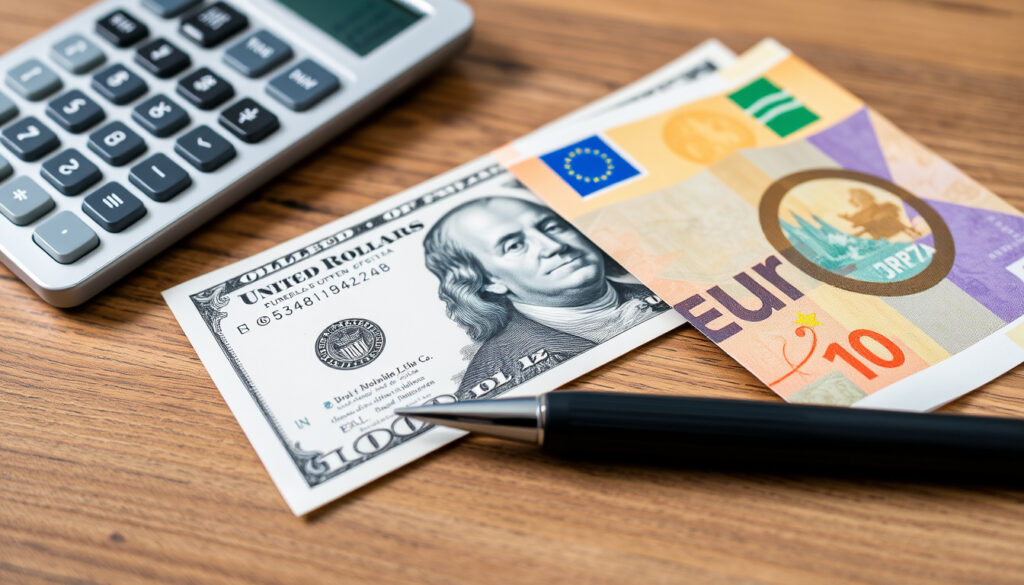
Convert USD to EUR: Manually Convert Dollars to Euros
You’ve probably checked the exchange rate before a trip or a transfer, wondering how much your dollars are worth in euros, but the number you see online isn’t always what you’ll get at the bank or currency kiosk. This guide explains how to manually convert USD to EUR, why rates differ, and how to get the best deal.
Current USD/EUR exchange rate: 0.92 (indicative mid-market rate) ·
Daily forex market volume: $6.6 trillion ·
Most common conversion amount: $100 ·
Typical bank fee above mid-market: 1-3%
Quick snapshot
- Manual conversion uses multiplication by the exchange rate (Western Union (financial services))
- Banks add a markup to the mid-market rate (Wise (online transfer service))
- ECB publishes reference rates daily at ~16:00 CET (European Central Bank (eurozone central bank))
- Future direction of USD/EUR exchange rate
- Impact of specific political policies on the rate
- ECB reference rates updated every working day around 16:00 CET (Central Bank of Malta (national central bank))
- XE mid-market rate as of 12:28 UTC on July 11, 2026 (Xe (currency converter))
- Monitor Fed and ECB interest rate decisions for volatility. For more on Irish financial planning, check our State Pension (Contributory) Ireland 2026: Rates & Rules
- Use mid-market rate tools for accurate comparison (State Pension (Contributory) Ireland 2026: Rates & Rules)
Four key facts, one pattern: the currency market moves fast, and the rate you see is rarely the rate you get.
| Label | Value |
|---|---|
| USD symbol | $ |
| EUR symbol | € |
| Current rate (1 USD to EUR) | 0.92 (indicative) |
| Global forex daily volume | $6.6 trillion |
How much is $100 US in euros?
How much is $1 in euros right now?
- XE (currency converter) reports a mid-market rate of 1 USD = 0.8761 EUR as of July 11, 2026.
- Wise (online transfer service) shows a similar rate of 1 USD = 0.8664 EUR in March 2026.
- Revolut (digital banking) lists a live rate around 1 USD = 0.86320 EUR, noting fees may apply (Revolut).
What’s €300 in US dollars?
To convert euros back to dollars, divide the euro amount by the USD/EUR rate. Using the XE rate of 0.8761, €300 ÷ 0.8761 = about $342.50. Different providers will give slightly different results because of their markups (CurrencyTransfer (comparison service)).
How much is 1,000 USD to EUR?
At the same mid-market rate, $1,000 equals 876.10 EUR. But if your bank adds a 2% fee, you’d receive only about 858.60 EUR. The difference adds up quickly on larger transfers (U.S. News (consumer finance)).
The mid-market rate is the baseline; every dollar above that is a dollar you lose to fees or markup. For a $1,000 transfer, a 2% fee costs you nearly $20 — money that could buy a nice dinner in Europe.
The implication: the rate you see on a converter is a snapshot; the actual amount you receive depends on the provider’s markup. Always compare the total cost, not just the headline rate.
How do I convert USD to euro manually?
What is the equation to convert dollars to euros?
- From base currency (USD) to quote currency (EUR): multiply the dollar amount by the exchange rate (EUR per USD). Example: $100 × 0.8761 = 87.61 EUR (ACT Learning (treasury professionals)).
- To go the other way (EUR to USD): divide the euro amount by the same rate, or multiply by the inverse (USD per EUR).
How to calculate exchange rates?
If you don’t know the rate, you can derive it by dividing the starting amount by the ending amount. For example, if $100 buys €87.61, the rate is 87.61 ÷ 100 = 0.8761.
Knowing the manual formula lets you verify any online converter’s output. If a calculator shows a different result, the provider is likely adding a hidden markup.
The trade-off: manual math is free and accurate, but the rate you use must be the mid-market rate, not the advertised rate from a bank or airport kiosk.
How to calculate exchange rates
What is the mid-market rate?
- The mid-market rate (also called interbank rate) is the rate at which banks trade currencies with each other. It’s the purest rate available, with no markup added.
- The European Central Bank publishes a daily reference rate, typically around 16:00 CET, based on a regular concertation procedure between central banks.
How to find the best exchange rate?
Compare the rates offered by banks, online services, and physical exchange counters. Bank of America provides a foreign exchange currency converter for U.S. dollars (Bank of America (U.S. bank)), but retail rates usually include a spread. Online services like Wise and Revolut advertise the mid-market rate but add a transparent fee. The best rate is the one closest to the mid-market rate after all fees.
The pattern: the closer you get to the mid-market rate, the more you keep. Airport kiosks and hotels charge the highest spreads — sometimes 5-10% according to travel expert Rick Steves (Rick Steves (travel expert)).
Is the dollar falling against the euro?
Is USD getting stronger to Euro?
- Currency strength fluctuates daily based on interest rate differentials, inflation data, and geopolitical events. The USD/EUR rate has moved from around 0.85 in early 2024 to above 0.90 in mid-2025, indicating a weaker dollar relative to the euro.
- As of July 2026, the ECB reference rate showed 1 USD = 0.8761 EUR (ECB Data Portal (currency converter)), while the Bank of Lithuania republishes these rates daily (Bank of Lithuania (central bank)).
Is USD expected to rise against EUR?
Forecasts vary. The Fed’s interest rate decisions, U.S. fiscal policy, and eurozone economic performance all play a role. The direction is uncertain, which is why the “what’s unclear” card flags it. For now, the dollar has weakened modestly against the euro over the past year.
The catch: predicting exchange rates is notoriously difficult. What matters more for your conversion is the rate at the moment you trade, not the long-term trend.
What is a good exchange rate for dollars to euros?
Why does Trump want a weaker U.S. dollar?
Political leaders sometimes advocate for a weaker dollar to boost exports, because a cheaper dollar makes U.S. goods more competitive abroad. However, such policy statements can influence market sentiment and cause short-term volatility in the USD/EUR rate.
How to get the best exchange rate?
- Avoid high-fee channels: Airport currency exchange kiosks and hotel desks charge the highest markups, often 5-10%.
- Use a bank or credit union: U.S. News advises checking rates and fees with a bank or credit union before exchanging foreign currency (U.S. News (consumer finance)).
- Choose online transfer services: Wise, Revolut, and similar platforms offer near-mid-market rates with transparent fees.
- Monitor the rate: Set alerts on XE or Wise to catch favorable moves.
The implication: a “good” rate is one that minimizes the gap between the mid-market rate and what you actually receive. Anything above 1-2% markup is expensive.
Comparison of currency conversion providers
Three providers, one clear distinction: online services consistently beat banks and physical exchange counters on cost.
| Provider | Rate type | Typical markup | Best for |
|---|---|---|---|
| Wise / Revolut | Mid-market rate + transparent fee | 0.5-1% | Online transfers and travel spending |
| Bank (e.g., Bank of America) | Retail rate with spread | 1-3% | Account holders, pre-trip exchange |
| Airport kiosk / hotel | Retail rate with high spread | 5-10% | Emergency cash only |
The pattern: the more convenient the channel, the higher the cost. Plan ahead to use online services and save.
How to convert USD to EUR in 5 steps
- Check the current mid-market rate using XE, Wise, or the ECB converter.
- Multiply your dollar amount by the rate (e.g., $500 × 0.8761 = 438.05 EUR).
- Subtract any fees the provider charges. Online services show a transparent fee; banks often hide it in the spread.
- Compare 2-3 providers to find the lowest total cost.
- Execute the transfer when the rate is favorable. Set a rate alert if you’re not in a rush.
The pattern: having a clear, step-by-step strategy removes the guesswork from currency conversion and puts you in control of the costs.
What’s confirmed and what’s unclear
Confirmed facts
- Exchange rates fluctuate based on market forces (ECB)
- Manual conversion uses multiplication by the exchange rate (Western Union)
- Banks add a markup to the mid-market rate (Wise)
What’s unclear
- Future direction of the USD/EUR exchange rate
- Impact of specific political policies on the exchange rate
The takeaway: while the future direction of the USD/EUR rate is unknown, the mechanics of getting the best deal are well-established and within your control.
Expert perspectives
“The mid-market rate is the rate used by banks and financial institutions. It’s the fairest benchmark for any currency conversion.”
— Spokesperson, XE (currency converter provider)
“Travelers can lose about 5 to 10 percent when converting dollars to euros or another foreign currency. Avoid airport exchange counters if possible.”
— Rick Steves, travel expert
For anyone sending money abroad, the choice is clear: use a mid-market rate provider like Wise or Revolut, or pay up to 5% more at a bank or airport kiosk. The best deal is the one you plan ahead for.
Frequently asked questions
How do I convert USD to EUR online?
Use a service like XE, Wise, or Revolut. Enter the amount, and they’ll show the mid-market rate plus any fees. Confirm and send.
What is the best time to convert currency?
Weekdays during European trading hours (9:00-17:00 CET) when liquidity is highest. Avoid weekends when markets are closed.
Do banks charge for currency conversion?
Yes, they add a markup to the mid-market rate, typically 1-3%. Some also charge a flat fee.
Can I convert USD to EUR at airports?
Yes, but rates are poor — often 5-10% above the mid-market rate. Use only for emergency cash.
What is the difference between spot rate and forward rate?
The spot rate is for immediate delivery; the forward rate is a locked-in rate for a future date, used by businesses to hedge risk.
How often do exchange rates update?
Mid-market rates update continuously during market hours. ECB reference rates update once per working day at ~16:00 CET.
Is it better to convert in the US or Europe?
It depends on fees. Online services work the same both sides. Bank ATMs in Europe often offer better rates than US airport kiosks.
More related posts
 State Pension (Contributory) Ireland 2026: Rates & Rules
 เว็บสล็อตชนะ pglucky88.win: Review and Verification
 Things to Do in Cork with Kids: Guide to Top 7 Spots
 Apple Watch SE 3 – Release Date, Price and Specs
 Coca-Cola Share Price: Live KO Quote, Forecast & Dividend
 Second Class Honours Grade 1: Meaning, GPA, and FAQs
 TikTok Coin Recharge: Cheapest, Safest & Free Methods (2025)
