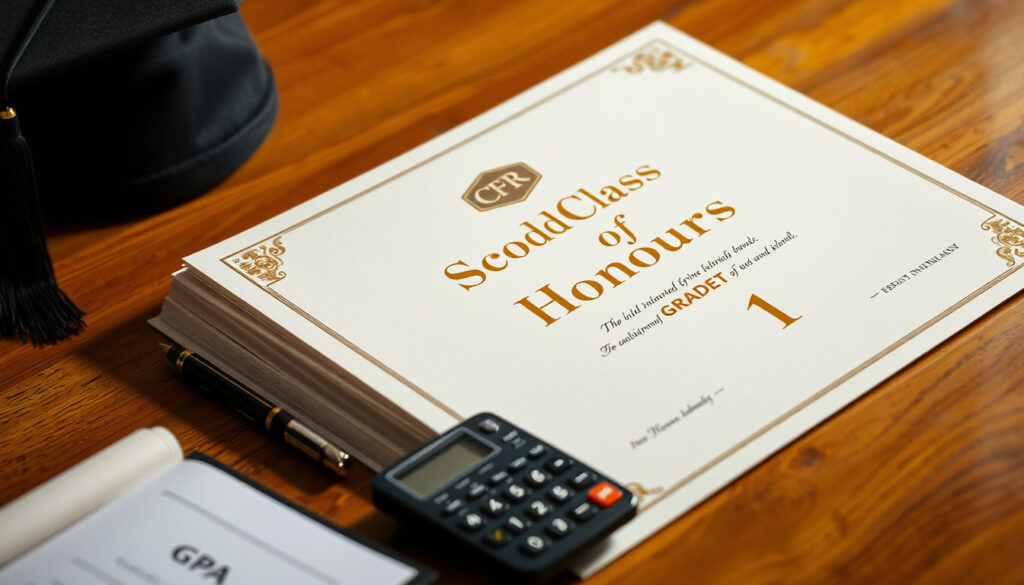
Second Class Honours Grade 1: Meaning, GPA, and FAQs
Few academic benchmarks carry as much weight in Ireland as a 2.1 – the grade that can unlock graduate schemes and postgraduate places, but the exact percentage needed and GPA translation varies by university. Here we break down what second class honours grade 1 means, from UCC’s 60–69% boundary to UCD’s 3.08–3.67 GPA range, to help you understand where you stand.
Percentage Range: 60-69% ·
UCD GPA Range: 3.08–3.67 ·
Also Known As: Upper Second Class (2.1), Merit Grade 1 ·
Classification Rank: Second highest (below First Class Honours)
Quick snapshot
- 2.1 requires 60-69% at UCC (UCC Students’ Union (official student body))
- At UCD, 2H1 GPA is 3.08–3.67 (University College Dublin (Irish university))
- Merit Grade 1 = 2.1, needs 60%+ (Technological University of the Shannon (Irish university))
- Exact GPA equivalence varies across institutions; not all publish standardised tables
- Employer criteria for 2.1 may differ by industry and country
- The impact of year weighting on classification is not always publicly documented
- Most Irish universities exclude first-year marks from final classification, weighting later years (UCC Students’ Union)
- A 2.1 is often the minimum grade for graduate schemes and Master’s programmes (SmartCGPA (degree classification tool))
Six key attributes define the 2.1, one pattern: while the percentage band is consistent (60–69%), the GPA equivalent shifts by institution.
| Label | Value |
|---|---|
| Full Name | Second Class Honours, Grade 1 |
| Abbreviation | 2.1, 2H1 |
| Percentage Range | 60-69% |
| UCD GPA | 3.08–3.67 |
| IADT GPA | 3.00 |
| Common Names | Upper Second Class Honours, Merit Grade 1 |
For students applying to jobs or further study, knowing the exact GPA of your institution is critical — one place’s 3.0 can be another’s 3.67, and that can change what you’re eligible for.
What is a 2.1 degree in Ireland?
- Definition of Second Class Honours Grade 1 — It is the second-highest classification in the Irish honours degree system, typically awarded for achieving 60–69% of total marks (UCC Students’ Union (student representation body)).
- Common names: 2.1, Upper Second Class — The designation “2.1” is used universally across Irish universities, while “Upper Second Class Honours” is the formal label (GPA Calculator (grade conversion resource)).
- Typical percentage range — The 60–69% band is the consistent measure, though some conversion tools split this into finer grades (e.g., 65–69.99% = A-, 60–64.99% = B+) within the same classification (Scholaro (international grading profile)).
The implication: while the label sounds uniform, the same 2.1 can represent slightly different grade distributions depending on the university’s internal marking scale.
What GPA is a 2.1 honours degree in Ireland?
- GPA range at UCD — At University College Dublin, a Second Class Honours Grade 1 (2H1) corresponds to a GPA of 3.08 to 3.67 inclusive (University College Dublin (major Irish university)).
- GPA range at IADT — The Institute of Art, Design + Technology (IADT) maps a 2nd Class Honours Grade 1 to a GPA of exactly 3.00 (IADT (specialist design and technology institute)).
- General GPA equivalence — Broad conversion tools like GPA Calculator assign a simplified 3.0 GPA to Irish upper second-class honours, while Scholaro uses a split band (A- / B+) averaging around 3.3–3.7 (GPA Calculator; Scholaro).
The catch: there is no single national GPA standard. If you’re applying abroad, you’ll need to check each institution’s conversion table rather than relying on a one-size-fits-all number.
A student with a 2.1 from IADT (GPA 3.00) might be at a disadvantage compared to a UCD graduate (GPA 3.08–3.67) when applying to US postgraduate programmes, simply because the conversion table varies — not because of actual academic difference.
What this means: students should verify conversion tables for their target institutions.
What is a merit grade 1 in Ireland?
- Merit Grade 1 and 2.1 equivalence — In some institutions, particularly technological universities, “Merit Grade 1” is the exact synonym for Second Class Honours Grade 1 (Technological University of the Shannon (TUS, Irish university)).
- Institutions that use Merit terminology — TUS and other technological universities use “Merit Grade 1” to align with the broader national framework (TUS).
- Difference from Merit Grade 2 — While Merit Grade 1 requires at least 60% of total marks, Merit Grade 2 corresponds to the 50–59% range (Second Class Honours Grade 2) (TUS).
The pattern: whether it says “Merit Grade 1” or “2.1”, the percentage threshold is the same — but the label matters when your transcript is read by an international recruiter who may not recognise the local terminology.
Is second class honours grade 1 good?
- Employer perception of a 2.1 — A 2.1 is widely regarded as a strong achievement. Many graduate schemes and professional roles set it as the minimum entry requirement, making it a de facto standard for competitive hiring (SmartCGPA (degree classification tool)).
- Graduate job prospects — In fields like accounting, law, and technology, a 2.1 is often the threshold for interview shortlisting. Employers view it as evidence of solid academic ability without the pressure of a First (GPA Calculator).
- Comparison with 2.2 and First Class — It sits comfortably between the 2.2 (50–59%) and First Class Honours (70%+). For most roles, a 2.1 is sufficient; a 2.2 may close doors, while a First provides a marginal edge (UCC Students’ Union).
What this means: a 2.1 is the safe bet — it keeps almost every option open without the pressure of First Class expectations. However, for highly competitive fields (e.g., investment banking), a First can still be a differentiator.
Which is better, 2.1 or 2.2 degrees?
- Grade boundaries — A 2.1 (60–69%) is a full grade band above a 2.2 (50–59%). The difference of 10 percentage points can translate into very different career trajectories (UCC Students’ Union).
- Career implications — Many graduate employers explicitly require a 2.1; a 2.2 may be accepted only with additional experience or strong interview performance (SmartCGPA).
- Postgraduate admission — Master’s programmes, especially taught ones, typically ask for a 2.1 or equivalent. A 2.2 may require a postgraduate diploma route or professional experience to compensate (GPA Calculator).
The trade-off: a 2.1 opens the door; a 2.2 means you’ll need to prove yourself more through experience, references, or additional qualifications.
Five classifications compared, one pattern: the 2.1 is the most common cutoff for progression — and the drop to a 2.2 significantly narrows options.
| Classification | Percentage Range | Common GPA Equivalent | Employer / Postgrad Threshold |
|---|---|---|---|
| First Class Honours (1.1) | 70–100% | 3.7–4.0 | Often preferred, rarely required |
| Second Class Honours Grade 1 (2.1) | 60–69% | 3.0–3.67 | Minimum for most schemes and Master’s |
| Second Class Honours Grade 2 (2.2) | 50–59% | 2.5–2.99 | Often below threshold; may need justification |
| Third Class Honours (3rd) | 40–49% | 2.0–2.49 | Rarely considered for graduate roles |
| Pass (without honours) | 35–39% | Below 2.0 | Limited options without further study |
Upsides
- Widely recognised benchmark for graduate employment
- Opens doors to most Master’s programmes
- Achievable target for most students
Downsides
- Not as competitive as a First in top-tier industries
- GPA conversion can hurt international applications
- Variation in calculation methods (year weightings) creates uncertainty
This comparison shows the stark difference between the 2.1 and 2.2 bands.
Confirmed facts and what’s unclear
- Confirmed: 2.1 requires 60-69% of total marks (UCCSU).
- Confirmed: UCD GPA range for 2H1 is 3.08–3.67 (UCD).
- Confirmed: Merit Grade 1 requires at least 60% (TUS).
- Unclear: Exact GPA equivalence varies across institutions; not all publish standardised tables.
- Unclear: Employer criteria for 2.1 may differ by industry and country.
- Unclear: The impact of year weighting on classification is not always publicly documented.
These facts clarify the practical implications of the 2.1 classification.
“60-69% – 2.1 – Second Class Honours, Grade 1”
UCC Students’ Union (student representation body)
“2H1 corresponds to GPA 3.08 to 3.67”
University College Dublin (Irish university)
“Second Class Honours Grade 1/Merit Grade 1 requires at least 60% of total marks”
Technological University of the Shannon (Irish university)
For Irish students preparing to enter the job market or apply for further study, the choice is clear: a 2.1 keeps most doors open, while falling to a 2.2 forces you to rely on experience and networking. Aim for the 60% line — and check your university’s specific GPA table if you’re planning to go abroad.
For a detailed comparison, see our guide on upper second class honours, which explains the 2:1 classification in the UK system.
Frequently asked questions
What subjects require a 2.1 for progression?
Many professional programmes in law, engineering, and accountancy set a 2.1 as the minimum for honours-level progression or professional accreditation. For example, Chartered Accountants Ireland expects a 2.1 for fast-track entry (check respective professional bodies).
Can I get a 2.1 if my average is 59%?
Not without rounding policies. Most universities do not round up; 59% typically falls into the 2.2 band. However, some courses have borderlines or compensate with module weighting — check your university’s policy.
How does the weighting of years affect the classification?
Typically first-year marks are excluded; second and third or final years are weighted (e.g., 20% second year, 80% final year). UCCSU notes that courses differ in how much weight each year carries (UCC Students’ Union).
Is a 2.1 the same as a B+?
Not exactly. In the Irish context, 60-64% is often considered B+ (or 2.1 borderline), while 65-69% is A- (also 2.1). Scholaro’s conversion treats 60-64.990 as B+ and 65-69.990 as A- within the same classification (Scholaro).
Does a 2.1 guarantee a job?
No, but it removes the most common initial barrier. Many graduate schemes use it as a filter; beyond that, interview performance, experience, and soft skills decide the outcome.
How is second class honours grade 1 calculated at Trinity College Dublin?
Trinity uses a percentage system similar to UCC: 2.1 requires 60-69%. However, the college also applies weighting schemes that can vary by faculty. Always check TCD’s official academic registry page.
What is the difference between second class honours grade 1 and first class honours?
A first class (1.1) requires 70% or above. The 10-percentage-point gap often reflects a higher degree of independence and analytical depth in dissertations or final exams.
Can international students convert their grades to a 2.1 equivalent?
Yes, using recognised conversion services (WES, Scholaro, or individual university equivalency tables). However, the exact mapping can vary, so apply to each destination programme with the conversion from their preferred service.
More related posts
 Last Minute Hotel Deals Ireland: Best Sites & Tips for 2025
 1 on 1 Video Call: Best Free Platforms Compared
 The Boy in the Striped Pyjamas – Plot Summary, Ending and Themes
 Slow Cooker Beef Stroganoff Recipe: Easy & Tender
 Maximum Dose of Sertraline for Adults: 200 mg Limit
 St Stephen’s Green Shopping Centre: Shops, History & Plans
 How to Do a Factory Reset on Android: All Methods Guide
 Kaya Scodelario Movies & TV Shows: Complete Filmography
