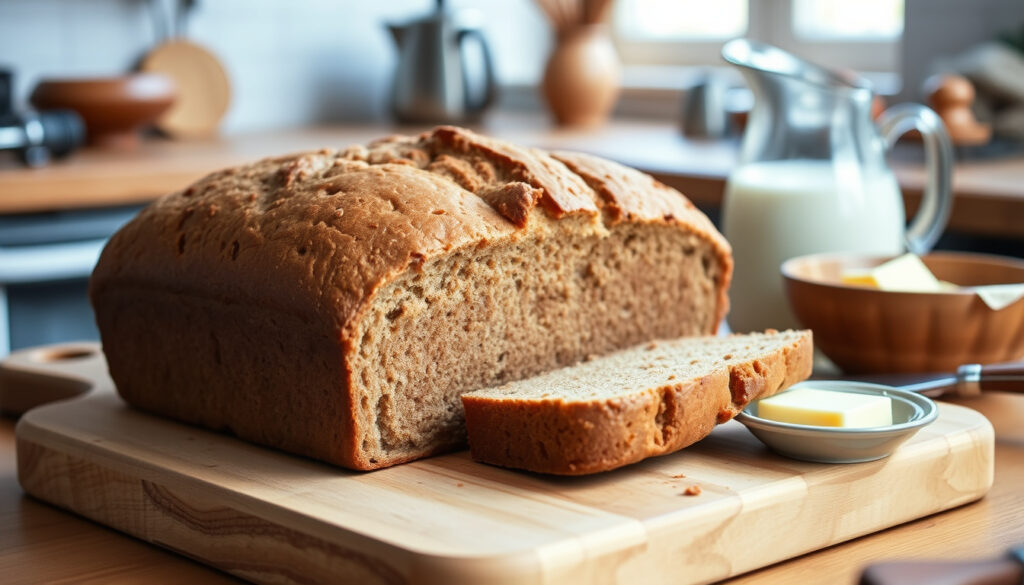
Odlums Brown Bread with Buttermilk: Traditional Irish Recipe
There’s something about the smell of freshly baked brown bread that feels like coming home — especially when it’s made with Odlums wholemeal flour and a good splash of buttermilk. This classic Irish soda bread relies on a clever chemical reaction rather than yeast to rise, and understanding the role of buttermilk and choosing the right flour can make the difference between a dense brick and a tender, golden loaf.
Prep Time: 15 minutes ·
Bake Time: 35 minutes ·
Servings: 1 loaf ·
Difficulty: Easy ·
Main Flour: Odlums Coarse Wholemeal Flour
Quick snapshot
- Buttermilk acidity reacts with baking soda to leaven the bread (Odlums, Ireland’s trusted flour brand)
- Traditional brown bread uses bicarbonate of soda, no yeast (Dublin Journal, Irish lifestyle outlet)
- Odlums recipe has been publicly promoted since at least 2017 (Odlums YouTube channel)
- Exact buttermilk amount varies by flour brand absorption
- Historical origin date of the Odlums recipe is uncertain
- Whether honey can be replaced without altering texture
- Odlums published a video of the recipe on 2017-06-07 (Odlums YouTube channel)
- Guinness brown bread variant shared by Odlums on 2022-03-16 (Odlums YouTube channel)
- Food Ireland published a similar Guinness brown bread recipe on 2014-01-15 (Food Ireland, Irish recipe hub)
- Serve warm with butter and a strong cup of tea
- Store wrapped in a tea towel to keep crust soft
- Experiment with adding seeds or oats for variation
Five key details, one pattern: the Odlums recipe balances wholemeal texture with buttermilk’s acidity to create a moist, tender bread that needs no yeast.
| Attribute | Value |
|---|---|
| Country of origin | Ireland |
| Main ingredients | Wholemeal flour, buttermilk, baking soda, salt |
| Bake temperature | 200°C then 190°C |
| Typical bake time | 35 minutes |
| Serving | With butter and tea |
The pattern: these five attributes define the Odlums baseline that Irish home bakers have trusted for generations.
What does buttermilk do to bread?
How does buttermilk affect texture?
- The lactic acid in buttermilk reacts with bicarbonate of soda to produce carbon dioxide gas, creating a light, airy crumb (Odlums, Ireland’s trusted flour brand).
- Buttermilk also adds moisture and a mild tang, tenderising the gluten network so the bread stays soft rather than tough.
- A Dublin Journal summary confirms that this acid‑base reaction is what makes traditional brown bread rise without yeast.
The implication: without buttermilk’s acidity, soda bread would be dense and flat. The acid is non‑negotiable.
Can you substitute milk for buttermilk?
- Plain milk lacks the acid needed to activate baking soda, so it won’t produce the same rise (Rosemary Mark, US food blogger and baker).
- You can create a buttermilk substitute by adding 1 tablespoon of lemon juice or white vinegar to 240 ml of milk and letting it sit for 5 minutes.
- Yogurt thinned with water also works as a replacement, though the tang will be milder.
The catch: using a substitute changes the flavour profile slightly, but the chemical reaction still works if the acidity is correct.
When should you avoid buttermilk?
- If you want a neutral‑tasting bread (like a sandwich loaf), buttermilk’s tang might clash.
- In recipes that rely on yeast for flavor development, buttermilk can overpower delicate notes.
- For those with lactose intolerance, buttermilk contains lactose, though less than whole milk due to fermentation.
The trade‑off: buttermilk gives traditional Irish brown bread its signature character; avoid it only if you’re after a completely neutral base.
Home bakers in Ireland who switch to milk without adding an acid will end up with a flat, sad loaf. The acid‑base pairing is the engine of soda bread — skip it and the chemistry fails.
How to make traditional Irish brown bread?
Ingredients for authentic Irish brown bread
- 200g cream plain flour
- 250g Odlums coarse wholemeal flour
- 1 tsp bread soda (bicarbonate of soda)
- 1 tsp salt
- 1 tsp cream of tartar
- 25g oat bran, wheat germ and wheat bran (combined)
- 25g butter or margarine
- 1 tbsp honey
- 1 beaten egg
- 350–400 ml buttermilk
All measurements follow the Odlums official recipe from their website, the primary source for this guide.
Step-by-step method
- Preheat the oven to 210°C/425°F/Gas 7 (Odlums, Ireland’s trusted flour brand).
- Sift together the cream plain flour, bread soda, salt and cream of tartar. Then stir in the wholemeal flour, oat bran, wheat germ and wheat bran.
- Rub the butter or margarine into the dry mix until it resembles fine breadcrumbs.
- In a separate bowl, beat the egg and honey together, then add the buttermilk. Pour this liquid into the dry ingredients and mix to form a soft dough.
- Turn the dough onto a floured board and knead lightly for one minute. Shape and place into a prepared 2lb loaf tin (or two smaller tins).
- Cut a deep cross on top of the loaf — this helps the bread rise evenly.
- Bake at the high temperature for 15 minutes, then reduce to 190°C/375°F/Gas 5 and bake for about 30 minutes more.
- The bread is cooked when it sounds hollow when tapped underneath. Wrap in a clean tea towel to cool (Odlums, Ireland’s trusted flour brand).
Why this matters: cutting the cross isn’t just tradition — it allows the centre to expand without cracking the crust. The tea‑towelling step keeps the crust soft, which is how Irish brown bread is meant to be eaten.
Tips for perfect brown bread
- Don’t over‑knead; the dough should be soft and sticky, not stiff. Add extra buttermilk if needed.
- Flour brands absorb liquid differently — start with 350 ml buttermilk and add more if the mixture is too dry (Odlums, Ireland’s trusted flour brand).
- For a denser, nuttier loaf, replace the cream plain flour with additional wholemeal flour.
Irish home bakers get the most reliable results by trusting Odlums’ ingredient ratios and temperature schedule. Deviate from the 15‑minute high‑heat start and the crust won’t set properly.
How much buttermilk do you need for Irish brown bread?
Buttermilk quantity variations
- The Odlums official recipe specifies 350–400 ml, noting that flour absorption varies by brand and humidity.
- Some home bakers use up to 425 ml when working with very coarse wholemeal flour.
- A French‑language Irish recipe site recommends a dough that is “dense and moist rather than liquid” (Irish Eyes, French‑Irish baking resource).
The pattern: the quantity is a range, not a fixed number. The key visual cue is a soft, shaggy dough that holds together but still looks slightly rough.
What if dough is too dry?
- Add buttermilk one tablespoon at a time until the dough comes together.
- If you run out of buttermilk, mixing a splash of regular milk with a squeeze of lemon juice can save the batch.
- A dough that’s too dry will produce a crumbly, dry loaf after baking.
The trade‑off: too much buttermilk makes the dough sticky and hard to shape, but a slightly stickier dough yields a moister baked loaf.
What is the best flour for brown bread?
Wholemeal flour vs plain flour
- Traditional Irish brown bread uses coarse wholemeal flour for its hearty texture and nutritional value (Odlums, Ireland’s trusted flour brand).
- Many recipes, including Odlums’, use a 50/50 mix of wholemeal and white flour to lighten the crumb without losing the wholemeal character.
- Using 100% wholemeal produces a very dense loaf that may not rise as high.
Can I use all-purpose flour?
- Yes, but it changes the texture. All‑purpose (plain) flour alone gives a softer, less rustic crumb — closer to a sandwich bread.
- For authentic Irish brown bread, Odlums Coarse Wholemeal Flour is the gold standard because of its coarse grind and high bran content.
- A blend of half wholemeal and half plain flour is the most common compromise outside Ireland.
The implication: if you want the true Irish brown bread experience, source Odlums coarse wholemeal flour. It’s widely available in Irish supermarkets and from Odlums, Ireland’s trusted flour brand.
Can I make traditional Irish soda bread with buttermilk and no yeast?
Yes — that’s exactly what this recipe is. Irish soda bread is a quick bread, meaning it uses chemical leavening instead of yeast.
The role of bicarbonate of soda
- Bicarbonate of soda (bread soda) is an alkaline compound that releases carbon dioxide when it meets an acid (Dublin Journal, Irish lifestyle outlet).
- The reaction starts as soon as the buttermilk touches the dry ingredients, so the dough must be baked immediately — no proving time needed.
Why no yeast is needed
- Yeast ferments sugars slowly over hours; soda bread rises in minutes thanks to the acid‑soda reaction.
- This makes it an ideal last‑minute bread — from mixing to table in under an hour.
- Odlums confirms that their brown bread is “yeast‑free” in the official recipe notes.
“Mix the egg, honey and buttermilk together… turn onto a floured board and knead lightly.”
— Odlums, Ireland’s trusted flour brand
“Whisk together the buttermilk, molasses, oil and egg – the dough should be dense and moist.”
The catch: soda bread doesn’t store as long as yeast bread. It’s best eaten within two days, or frozen right after cooling.
homethoughtsfromabroad626.wordpress.com, mysteryloverskitchen.com, youtube.com, waivio.com, youtube.com
For a traditional Irish loaf that comes together in under an hour, try this Odlums brown bread with buttermilk recipe from Dublin Journal.
Frequently asked questions
Can I freeze Irish brown bread?
Yes. Wrap the cooled loaf tightly in cling film and then foil. Freeze for up to three months. Thaw at room temperature and reheat briefly in the oven to restore the crust.
How to store brown bread?
Wrap the loaf in a clean tea towel or store in a bread bin. Do not seal in plastic, as that traps moisture and softens the crust. Best eaten within two days of baking.
What if I don’t have buttermilk?
Make a substitute: add 1 tablespoon of lemon juice or white vinegar to 240 ml of milk and let it sit for 5 minutes. The milk will curdle and produce the acid needed for the reaction.
Is Odlums wholemeal flour available outside Ireland?
Odlums products are primarily sold in Ireland and the UK. Some international Irish grocery stores or online retailers may stock them. Alternatively, seek any coarse wholemeal flour labeled “stoneground” for a similar texture.
Can I use yogurt instead of buttermilk?
Yes. Plain yogurt thinned with a little water to the consistency of buttermilk works well. The acidity is similar, though the flavour will be slightly different.
Why is my brown bread too dense?
Possible causes: too little buttermilk (not enough acid to activate the soda), over‑kneading which develops gluten, or an oven that wasn’t hot enough at the start. Next time, ensure the dough is soft and sticky, and bake at 210°C for the first 15 minutes.
Can I add seeds or oats?
Absolutely. Fold in sunflower seeds, pumpkin seeds, or rolled oats after mixing the dry ingredients. Reduce the wholemeal flour by 20–30g to keep the dough balance.
For home bakers in Ireland, the choice is clear: stick with Odlums coarse wholemeal flour and buttermilk as the acid source, or risk a loaf that’s either too dense or lacks the tang that makes soda bread so satisfying. Those looking for more Irish food inspiration might also explore good restaurants in Dublin or check out our guide to sesame chicken nutrition for contrast with wholemeal baking.
More related posts
 Houses for Sale in Cahir: 2025 Listings & Agents Guide
 BMW M3 for Sale in Ireland: 2025 Prices, Listings & Tips
 Kissing the Blarney Stone: Legend, Risks & How to Do It
 Movies to Watch on Netflix: Top Picks for Every Audience
 How to Fix a Dryer: Common Problems and DIY Solutions
 House for Sale Cobh – Latest Listings, Prices and Trends
 Dyson 100 Trade-In at Currys: How to Get £100 Back
 Inter Milan vs FC Barcelona Timeline: History, Results, and Key Matches
