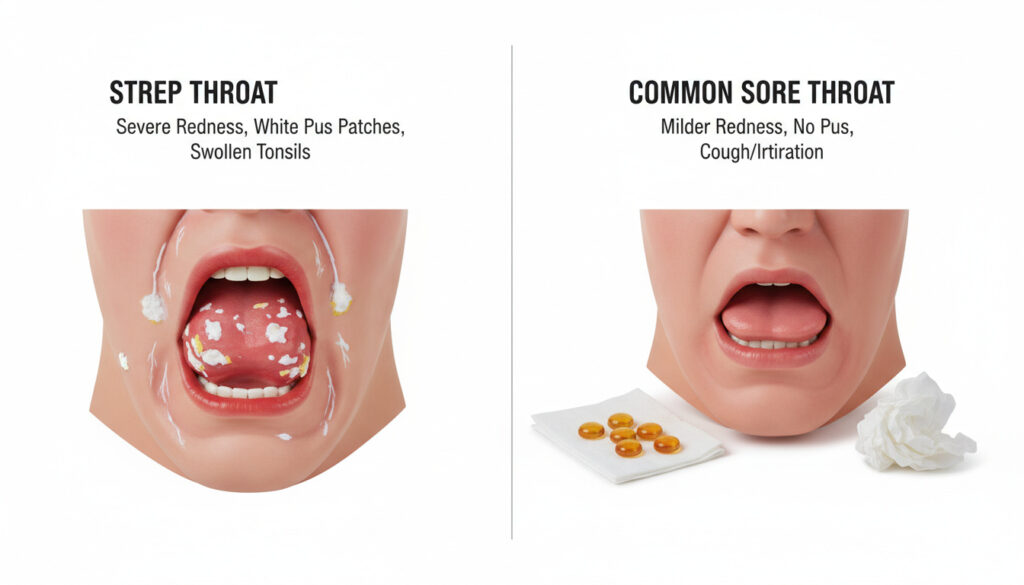
Symptoms of Strep Throat – Key Signs vs Sore Throat
Strep throat announces itself abruptly. Unlike the gradual scratchiness of a common cold, this bacterial infection triggers sharp pain within hours, often accompanied by fever and distinctive white patches on the tonsils.
Caused by Group A Streptococcus bacteria, the condition demands medical confirmation through testing. While viral sore throats typically resolve with rest, untreated strep poses risks of serious complications including rheumatic fever and kidney inflammation. The infection spreads through respiratory droplets, with symptoms typically surfacing two to five days after exposure.
Children ages five to fifteen face the highest risk, though adults in crowded environments remain vulnerable. Recognizing the specific symptom pattern helps distinguish this infection from routine seasonal illnesses and determines when antibiotic intervention becomes necessary.
What Are the Main Symptoms of Strep Throat?
Core Presentation
Sudden severe throat pain, fever above 100.4°F, red and swollen tonsils with white patches or pus streaks.
Key Differentiator
Absence of cough, nasal congestion, or hoarseness distinguishes strep from viral upper respiratory infections.
Typical Duration
Seven to ten days total course with antibiotics; symptoms improve within 24 to 48 hours of treatment initiation.
Confirmation Required
Rapid antigen test or throat culture provides definitive diagnosis; visual inspection alone cannot confirm strep.
- Symptoms emerge rapidly, typically 2 to 5 days after bacterial exposure, according to the Centers for Disease Control and Prevention.
- Throat pain develops quickly rather than gradually, distinguishing it from viral sore throats.
- Tiny red spots (petechiae) may appear on the roof of the mouth.
- Front neck lymph nodes become visibly swollen and tender.
- Patients typically experience pain during swallowing without accompanying cough.
- The infection rarely occurs in children under age three.
- Scarlet fever rash develops in some cases, indicating streptococcal infection.
| Characteristic | Strep Throat | Common Cold | Influenza |
|---|---|---|---|
| Onset Speed | Rapid (hours) | Gradual (days) | Sudden |
| Fever | High (101°F+) | Rare/Mild | High |
| Cough | Absent | Common | Common |
| Nasal Symptoms | Absent | Present | Present |
| Tonsil Appearance | Red with white patches | Normal/Mildly red | Normal |
| Headache | Common | Rare | Common |
| Body Aches | Sometimes | Rare | Severe |
| Swollen Lymph Nodes | Front neck, tender | Mild | Generalized |
How to Tell Strep Throat from a Sore Throat
Distinguishing streptococcal infection from viral pharyngitis requires attention to specific clinical markers. The absence of upper respiratory symptoms serves as the primary differentiator.
How Do You Know If You Have Strep Throat?
Clinical diagnosis requires laboratory confirmation. Healthcare providers perform rapid antigen detection tests or throat cultures to identify Group A Streptococcus. According to UC Davis Health, the combination of sudden throat pain, fever, and absence of cough strongly suggests bacterial infection. However, visual inspection alone proves insufficient; many viral infections mimic strep’s appearance.
Strep Throat vs Sore Throat Symptoms
Viral sore throats typically present with cough, runny nose, and hoarseness—symptoms notably absent in strep cases. Johns Hopkins Medicine emphasizes that strep throat generally lacks respiratory symptoms. If congestion accompanies throat pain, viral infection remains the more likely culprit.
Cough indicates viral infection rather than strep. The presence of nasal congestion, hoarseness, or cough suggests alternative diagnoses, making immediate strep testing less urgent unless other specific markers appear.
Strep Throat Symptoms in Adults vs Children
While the fundamental bacterial mechanism remains identical, symptomatic expression varies significantly between age groups. Young children often manifest atypical presentations that require careful parental observation.
Strep Throat Symptoms in Adults
Adult patients typically experience localized throat pain and fever, though manifestations may prove milder than pediatric cases. Mercy Health notes that adults may report less severe symptoms while still requiring antibiotic treatment. Headache and body aches occasionally accompany the primary throat discomfort, though systemic symptoms generally remain less pronounced than in children.
Strep Throat Symptoms in Children
Pediatric cases demand heightened vigilance. Young children may struggle to verbalize discomfort, instead presenting through behavioral changes. GoHealth UC identifies critical warning signs including refusal of favorite foods, unusual drooling, and difficulty swallowing. Children frequently experience abdominal pain, vomiting, and headache alongside standard throat symptoms.
Parents should monitor for dehydration indicators, persistent fever above 101°F, or difficulty breathing. Children may not complain of sore throat directly but will reject foods or liquids due to pain.
How Long Does Strep Throat Last and What Happens Next?
Understanding the temporal progression of streptococcal infection helps set realistic expectations for recovery and emphasizes the importance of medical intervention.
How Long Does Strep Throat Last?
With appropriate antibiotic therapy, symptoms typically improve within 24 to 48 hours, with complete resolution occurring within 7 to 10 days. Cleveland Clinic confirms this timeline contrasts sharply with untreated cases, which may persist longer and risk serious complications. Without antibiotics, the infection remains contagious for extended periods and poses substantial health risks.
Can Strep Throat Go Away on Its Own?
While the immune system occasionally clears the bacteria independently, self-resolution carries unacceptable risks. Allina Health emphasizes that untreated strep may lead to rheumatic fever, permanent heart valve damage, or kidney inflammation. Antibiotics remain essential not merely for symptom relief but for preventing these downstream complications. Viral sore throats typically resolve within five days without intervention, but strep requires pharmacological treatment.
Patients remain contagious for 24 to 48 hours after initiating antibiotic therapy. Without treatment, infectiousness persists for two to three weeks, significantly increasing transmission risk to family members and colleagues.
When Should You See a Doctor for Strep Throat Symptoms?
Timely medical consultation prevents complications and reduces transmission. Specific symptom combinations warrant immediate professional evaluation.
Contact healthcare providers when experiencing sore throat lasting longer than 48 hours, particularly when accompanied by tender swollen lymph glands or rash. Mayo Clinic recommends urgent care for breathing difficulties, swallowing problems, or blood in saliva. Fever exceeding 101°F persisting several days, dehydration signs, or drooling in children require prompt attention.
Once diagnosed, return for evaluation if no improvement occurs 48 hours after beginning antibiotics. This pattern may indicate antibiotic resistance, incorrect diagnosis, or complications requiring alternative interventions.
How Does Strep Throat Progress From Exposure to Recovery?
- Exposure and Incubation: The bacteria require 2 to 5 days to multiply before symptoms appear, during which asymptomatic transmission may occur.
- Initial Onset: Sudden severe throat pain emerges, often waking patients with intense discomfort. Fever spikes rapidly above 100.4°F.
- Peak Presentation: Days two through three bring maximum symptom intensity. Tonsils display white patches, lymph nodes swell significantly, and swallowing becomes painful.
- Treatment Response: Within 24 to 48 hours of antibiotic initiation, fever subsides and pain diminishes significantly. Contagiousness drops sharply.
- Complete Resolution: Full recovery occurs within 7 to 10 days of treatment, though energy levels may require additional recovery time.
What Is Definitively Known vs What Remains Uncertain About Strep Symptoms?
| Established Medical Facts | Uncertainties and Limitations |
|---|---|
| Group A Streptococcus bacteria cause the infection | Why some exposed individuals remain asymptomatic carriers |
| Symptoms appear 2-5 days post-exposure | Precise individual variation in incubation periods |
| Absence of cough distinguishes from viral infections | Cases presenting with atypical symptoms |
| Antibiotics prevent rheumatic fever and complications | Long-term gut microbiome impacts from antibiotic treatment |
| Rapid testing provides accurate diagnosis | False negative rates requiring culture confirmation |
The Bacteria and Risk Factors Behind Strep Throat
Group A Streptococcus pyogenes, a gram-positive bacterium, serves as the pathogenic agent. The microorganism spreads through respiratory droplets and direct contact, thriving in crowded environments such as schools and daycare facilities. Children between ages five and fifteen face disproportionate risk, while infants under three rarely contract the infection. Adults working in educational or healthcare settings encounter elevated exposure rates.
Strep Throat: Comprehensive Overview provides additional detail on transmission mechanics and prevention strategies. Complications extend beyond throat discomfort to potentially life-threatening conditions including post-streptococcal glomerulonephritis, scarlet fever characterized by sandpaper-like rashes, and invasive flesh infections.
Medical Authority Perspectives on Strep Throat
Strep throat is diagnosed with a rapid antigen test or throat culture. A healthcare provider typically performs a throat swab test.
— Cleveland Clinic
If strep has been diagnosed, seek care if there’s no improvement after taking antibiotics for 48 hours.
— Mayo Clinic
Untreated strep throat can lead to serious complications including rheumatic fever, which can cause permanent heart valve damage.
— Allina Health
Essential Points About Strep Throat Symptoms
Strep throat manifests through rapid-onset severe throat pain, fever, and characteristic white tonsillar patches, notably without cough or congestion. Accurate diagnosis requires laboratory testing rather than visual assessment alone. While children ages five to fifteen face highest risk, adults in crowded environments remain susceptible. Antibiotic treatment resolves symptoms within 24 to 48 hours and prevents serious complications including heart and kidney damage. Strep Throat: Comprehensive Overview offers expanded guidance on management protocols and prevention approaches.
Frequently Asked Questions
What are strep throat symptoms without fever?
While fever typically accompanies strep, some patients present with throat pain, swollen lymph nodes, and tonsillar white patches without elevated temperature. Absence of fever does not rule out infection; testing remains necessary for confirmation.
Can you have strep throat without a sore throat?
Atypical presentations occur, particularly in young children who may primarily experience abdominal pain, vomiting, or headache. Some carriers remain asymptomatic yet contagious, though classic cases include throat discomfort.
Is strep throat contagious?
Yes, transmission occurs through respiratory droplets. Infected individuals remain contagious for 24 to 48 hours after antibiotic initiation, or two to three weeks without treatment. Crowded environments facilitate rapid spread.
How is strep throat diagnosed?
Healthcare providers perform rapid antigen detection tests using throat swabs. Negative rapid tests may require throat culture confirmation. Visual inspection alone cannot distinguish strep from viral infections.
What happens if strep throat goes untreated?
Untreated cases risk rheumatic fever causing permanent heart damage, scarlet fever with characteristic rash, and kidney inflammation. While symptoms might resolve spontaneously, complications make antibiotic treatment essential.
Can strep throat cause a rash?
Yes, scarlet fever develops when streptococcal bacteria produce toxins causing sandpaper-like red rash, flushed face, and strawberry tongue. This complication requires immediate antibiotic treatment to prevent serious outcomes.
More related posts
 Fade Street Social Dublin: Menu, Dress Code & Rooftop Bar
 Dublin Zoo Wild Lights 2025 – Dates, Tickets and Full Guide
 State Pension (Contributory) Ireland 2026: Rates & Rules
 Galway United vs Bohemians: Match Result & Head-to-Head Analysis
 Post-Race Jockey Bust-Up: Wexford, Cheltenham, Doomben
 Why Is My Poop Green? Causes, When to Worry, and What to Do
 1 on 1 Video Call: Best Free Platforms Compared
 Charlie Kirk South Park – Parody Reaction and Controversy
