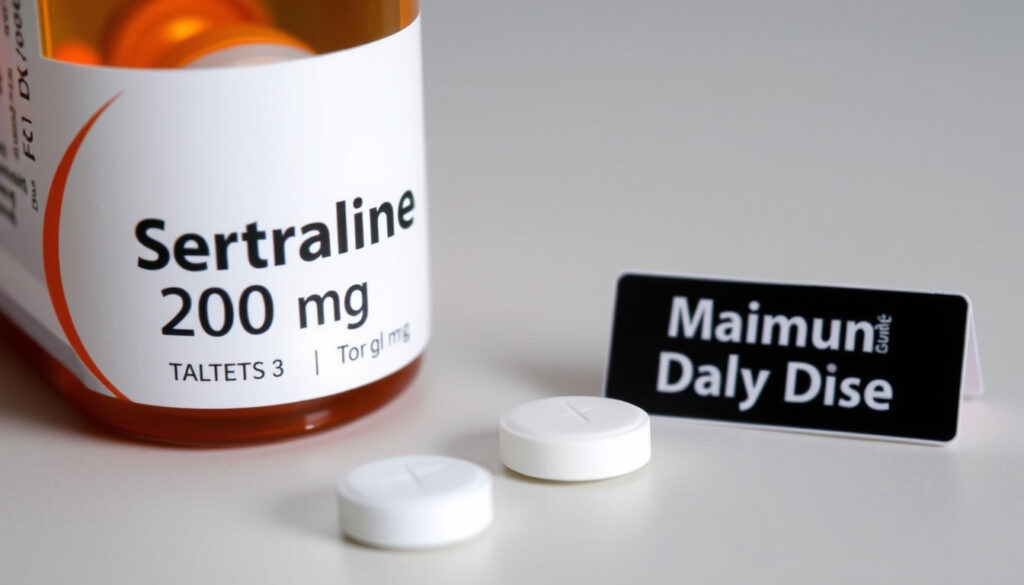
Maximum Dose of Sertraline for Adults: 200 mg Limit
If you’re taking sertraline or considering it, one question almost always comes up: how high can you safely go? The answer, backed by official prescribing sources, is clear: the maximum recommended dose of sertraline for adults is 200 mg per day, according to the HSE (Ireland’s health service) and Mayo Clinic (U.S. medical center).
Maximum daily dose for adults: 200 mg per day ·
Usual starting dose: 50 mg once daily ·
Minimum effective adult dose: 25 mg per day (initial titration) ·
Dose increment step: 50 mg at intervals of at least 1 week ·
Primary indication: depression, anxiety, OCD, PTSD, PMDD
Quick snapshot
- Maximum sertraline dose for adults is 200 mg/day (HSE)
- Usual starting dose is 50 mg/day (Mayo Clinic)
- Dose should not be increased more than once per week (NCBI Bookshelf)
- Optimal dose for specific subgroups (elderly, renal impairment) beyond general guidance
- Long-term safety of maximum 200 mg dose beyond 12 months in large populations
- Start at 50 mg (or 25 mg for anxiety/PTSD), increase by 50 mg every 7 days up to 200 mg (FDA Zoloft label)
- Typical maintenance dose achieved by week 4 of treatment (FDA Zoloft label)
- If 200 mg is ineffective, clinicians may consider switching to another SSRI or augmenting therapy
- Never exceed 200 mg without specialist supervision
| Label | Value |
|---|---|
| Maximum daily dose | 200 mg |
| Usual starting dose | 50 mg |
| Minimum adult dose | 25 mg (initial titration) |
| Dose increment | 50 mg steps |
| Minimum interval between dose changes | 1 week |
| Primary sources | HSE, Mayo Clinic, BNF/NICE, HPRA |
The pattern: every row reinforces a single ceiling of 200 mg, with the flexibility to start lower for specific conditions.
What is the maximum dose of sertraline for adults?
Maximum daily dose defined
- The maximum recommended sertraline dose for adults is 200 mg per day across all major health authorities (HSE, Mayo Clinic, FDA).
- Doses above 200 mg are not recommended and may increase the risk of serotonin syndrome (NCBI Bookshelf).
- The Pfizer label confirms the 200 mg ceiling for all approved indications.
The implication: this is a hard upper limit, not a suggestion. Exceeding it exposes patients to toxicity without added benefit.
Comparing 200 mg to standard doses
Six commonly used adult doses, one pattern: 25 mg, 50 mg, 100 mg, 150 mg, and 200 mg form a clear ladder. The 200 mg dose is 4× the starting dose for depression and 8× the starting dose for anxiety disorders.
- For depression and OCD: typical range is 50–200 mg daily (Mayo Clinic).
- For panic disorder, PTSD, and social anxiety: starting at 25 mg, max 200 mg (Pfizer labeling).
The catch: higher doses (150–200 mg) may be more effective for some patients but come with a steeper side-effect profile. The PubMed review notes that 50 mg/day is often sufficient for depression.
Patients who are not responding to 50 mg after 4 weeks should discuss a gradual increase with their prescriber, not self-dose. The 200 mg cap exists for a reason.
Is 100 mg of sertraline a high dose?
100 mg in context of titration
- 100 mg is double the typical starting dose of 50 mg and considered a moderate to high dose (Mayo Clinic).
- It is reached after one 50 mg increment, which requires at least 1 week of treatment at 50 mg (NCBI Bookshelf).
- Many patients stabilise at 100 mg for depression or anxiety.
What this means: 100 mg is not the ceiling, but it is a common intermediate step. Most official guidelines list 50–200 mg as the therapeutic range, so 100 mg sits comfortably in the middle.
When 100 mg is prescribed
- For depression not responding to 50 mg after 4 weeks, clinicians often increase to 100 mg (HSE).
- For OCD, the starting dose may already be 50 mg, and escalation to 100 mg is common.
- For premenstrual dysphoric disorder (PMDD), dosing is typically 50–150 mg/day, with 100 mg often effective.
The catch: while 100 mg is safe, it is not automatically better than 50 mg. The PubMed review found that 50 mg was effective for most patients with depression, so moving up should be based on clinical response, not assumption.
What is the typical dose of sertraline for adults?
Usual starting dose
- For depression and OCD: 50 mg once daily (Mayo Clinic).
- For panic disorder, PTSD, and social anxiety disorder: 25 mg once daily (Mayo Clinic).
- For PMDD: 50 mg daily, either continuously or during the luteal phase.
- Starting at 25 mg is recommended for patients with anxiety disorders to minimise initial side effects.
The pattern: the 25 mg start is a lower threshold for sensitive patients, while 50 mg is the default for most other indications.
Maintenance dose range
- Maintenance doses for depression and OCD: 50–200 mg once daily (NCBI Bookshelf).
- For panic disorder, PTSD, and social anxiety: 50–200 mg once daily, with many patients maintained at 50–100 mg.
- Dose increases are made in 50 mg increments at intervals of no less than 1 week (FDA label).
Why this matters: the maintenance dose is not one-size-fits-all. It depends on the condition, individual response, and tolerability.
Dose for anxiety vs. depression
- Anxiety disorders (panic, PTSD, social anxiety): start at 25 mg, titrate to 50–200 mg.
- Depression: start at 50 mg, titrate to 50–200 mg.
- OCD: same as depression, but sometimes requires higher doses within the range.
- PMDD: 50–150 mg, with 200 mg rarely needed.
The implication: the starting dose differs, but the target range is the same. The slower start for anxiety helps patients adjust to side effects.
Patients starting at 25 mg for anxiety may need a longer titration period to reach 200 mg, but the maximum cap remains unchanged. The Australian Government also advises gradual increases up to 200 mg only if necessary.
Before the spec table, here is a quick reference: seven key dosing parameters, one pattern — the 200 mg cap is universal, but the road to it varies by condition.
| Parameter | Value |
|---|---|
| Maximum daily dose | 200 mg |
| Typical starting dose (depression, OCD) | 50 mg once daily |
| Typical starting dose (panic, PTSD, social anxiety) | 25 mg once daily |
| Dose increment step | 25–50 mg |
| Minimum interval between increases | 1 week |
| Maintenance range (all indications) | 50–200 mg daily |
| Time to steady state | 5–7 days |
| Half-life | ~24–26 hours |
| FDA-approved indications | MDD, OCD, panic disorder, PTSD, social anxiety, PMDD |
| Primary prescriber guidance | HSE, Mayo Clinic, BNF/NICE |
The pattern: the 200 mg ceiling is universal, but the road to it varies by condition and patient tolerability.
Confirmed facts
- Maximum sertraline dose for adults is 200 mg/day (HSE)
- Usual starting dose is 50 mg/day (Mayo Clinic)
- Dose should not be increased more than once per week (NCBI Bookshelf)
What’s unclear
- Optimal dose for specific subgroups (elderly, renal impairment) beyond general guidance
- Long-term safety of maximum 200 mg dose beyond 12 months in large populations
“The usual adult dose of sertraline is 50 mg a day, and the dose may be increased gradually to a maximum daily dose of 200 mg.”
— HSE (Ireland’s health service)
“Sertraline is usually not more than 200 mg per day for adults.”
— Mayo Clinic (U.S. medical center)
“For depression, 50 mg/day is usually effective; doses may be increased in 50 mg/day increments at no less than weekly intervals to a maximum of 200 mg/day.”
For patients in Ireland or the UK, the choice is clear: follow the prescribed titration schedule from your GP or psychiatrist, never skip the weekly interval, and never exceed 200 mg without specialist supervision. The alternative is risking serotonin syndrome or a wasted medication trial.
drugs.com, connect.mayoclinic.org, drugs.com, mayoclinic.org, goodrx.com
Frequently asked questions
Can I take 300 mg of sertraline?
No. The maximum recommended dose is 200 mg per day. Taking 300 mg increases the risk of serotonin syndrome and other serious side effects. If you feel 200 mg is not working, talk to your doctor about switching to a different medication.
What should I do if I miss a dose of sertraline?
If you miss a dose, take it as soon as you remember, unless it is almost time for your next dose. In that case, skip the missed dose. Do not take a double dose to make up.
How long does it take for sertraline to work?
Most people start to feel some improvement within 2 to 4 weeks, but full therapeutic effects may take 6 to 8 weeks.
Can I drink alcohol while taking sertraline?
Alcohol can increase the sedative effects of sertraline and may worsen depression or anxiety. It is best to avoid alcohol or limit it to very small amounts.
Is sertraline safe for long-term use?
Yes, sertraline is approved for long-term use. However, regular check-ups with your doctor are recommended to monitor effectiveness and side effects.
What are the common side effects of sertraline?
Common side effects include nausea, diarrhoea, dry mouth, drowsiness, dizziness, and sexual dysfunction. These often improve after the first few weeks.
Can sertraline 200 mg cause serotonin syndrome?
Yes, particularly if combined with other serotonergic drugs. Symptoms include agitation, hallucinations, rapid heart rate, and high body temperature. Seek emergency help if these occur.
How do I stop taking sertraline safely?
Do not stop abruptly. Work with your doctor to taper the dose gradually over several weeks to avoid withdrawal symptoms such as dizziness, nausea, and anxiety.
More related posts
 Only YOU Hotel Málaga: Reviews, Rooftop Pool & Dining
 Force Majeure Leave Ireland: Days, Pay & How to Apply
 Sesame Chicken Near Me: What It Is, Nutrition, and Where to Order
 เว็บสล็อตชนะ pglucky88.win: Review and Verification
 The High Kings’ Rocky Road to Dublin Lyrics Meaning
 Ireland’s New Immigration Rules 2026: Asylum, Citizenship & More
 Sunderland AFC vs Leeds United Standings – Head-to-Head Record and Form Guide
 Homestore and More Athlone: Closure, Sale & Store Info
