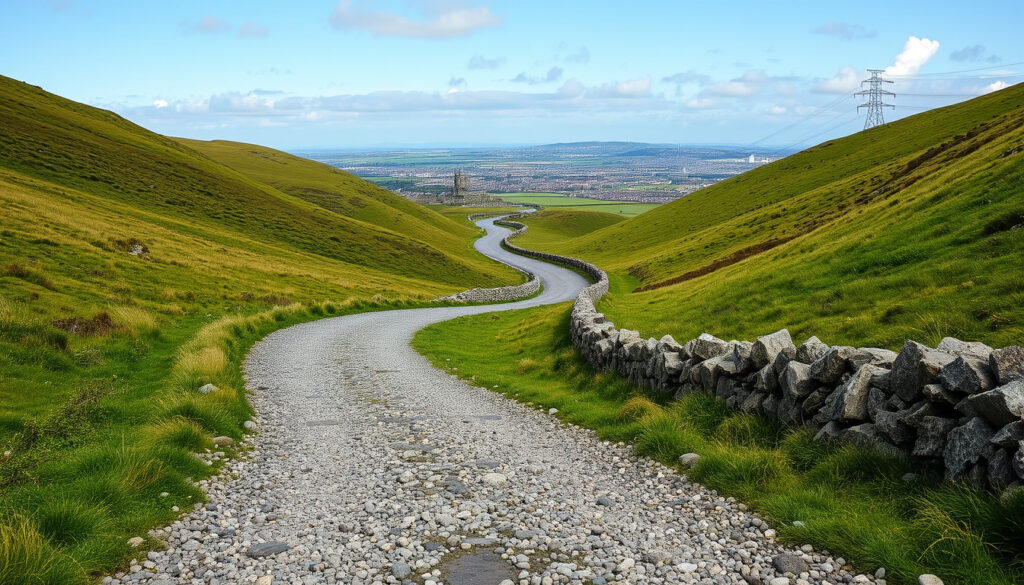
The High Kings’ Rocky Road to Dublin Lyrics Meaning
There’s a moment in nearly every Irish session where someone calls for “The Rocky Road to Dublin,” and the room shifts — feet start tapping before the first verse is done. This song has carried Irish emigrants across centuries, from the 19th-century lanes of Tuam to the global stage, most recently in the hands of The High Kings and the TV series *Sinners*.
Year of origin: mid-19th century (circa 1840s) ·
Number of verses: 7 ·
Most famous recording: The Dubliners (1960s) ·
The High Kings recording: 2008 ·
Length (The High Kings version): ~3:30 ·
Place of origin: Ireland (Tuam to Dublin route)
Quick snapshot
- Traditional Irish folk song (Wikipedia, the community-edited encyclopedia)
- First published in the 1840s (Folk Song and Music Hall, a specialist song archive)
- Likely written by D. K. Gavan (Folk Song and Music Hall, a specialist song archive)
- Journey from Tuam to Dublin (Wikipedia, the community-edited encyclopedia)
- Emigration and hardship (Irish American Mom, a cultural history site)
- Nonsense syllables as filler (Folk Song and Music Hall, a specialist song archive)
- The Dubliners (1960s) (Wikipedia, the community-edited encyclopedia)
- The High Kings (2008) (Wikipedia, the band’s article)
- Luke Kelly, The Pogues, other folk acts (Folk Song and Music Hall, a specialist song archive)
- Featured in TV series *Sinners* (2024) (IMDb, the film and TV database)
- Popular at Irish festivals (Irish American Mom, a cultural history site)
- Covered by many artists (Folk Song and Music Hall, a specialist song archive)
Here’s what the lyrics actually mean, where they came from, and why the journey still matters.
| Attribute | Value |
|---|---|
| Title | The Rocky Road to Dublin |
| Traditional | Yes, author unknown |
| First known publication | 1840s in a songbook |
| Common tune | A lively reel in 4/4 time |
| Length (The High Kings version) | Approximately 3 minutes 30 seconds |
What is the story behind the Rocky Road to Dublin?
What is the historical origin?
- The song is generally identified as a 19th-century Irish song written by D. K. Gavan (Wikipedia, the community-edited encyclopedia).
- One source states it was written for music-hall performer Harry Clifton (Irish American Mom, a cultural history site).
- First published in 1865, according to a folk-song reference (Folk Song and Music Hall, a specialist song archive).
Few songs capture the Irish emigrant experience as directly as this one. The “rocky road” isn’t just a road — it’s a metaphor for the hardship baked into the journey itself, as Irish American Mom, a cultural history site explains. The song doesn’t romanticize leaving home; it shows the bruises.
What does the journey represent?
- The song is about a man’s journey from Tuam, Ireland, to Liverpool, England (Wikipedia, the community-edited encyclopedia).
- The protagonist reaches Mullingar during the journey and attracts local attention there (Folk Song and Music Hall, a specialist song archive).
- The song depicts the narrator being robbed in Dublin, a major turning point (The Longest Song Wiki, a fan-built song database).
The implication: the journey is not a straight line to success. It’s a gauntlet — leaving family, crossing unfamiliar towns, getting fleeced in the city — before you even board the boat for England.
What do the lyrics of Rocky Road to Dublin mean?
What does musha rain dum a doo dum a da mean?
- The lyrics include nonsense syllables typical of Irish folk songs (Folk Song and Music Hall, a specialist song archive).
- These syllables serve as rhythmic filler rather than literal meaning (Wikipedia, the community-edited encyclopedia).
The most recognizable part of the song — “musha rain dum a doo dum a da” — carries no semantic meaning. It’s a placeholder that listeners across generations have filled with their own emotional weight. The nonsense becomes the sense.
What does rattlin over the bogs mean?
- “Rattlin’ over the bogs” refers to rough terrain — the literal bumpy ride across Irish peat bogs (Folk Song and Music Hall, a specialist song archive).
- The phrase reinforces the physical hardship of pre-modern travel in Ireland (Irish American Mom, a cultural history site).
What is the meaning of the Rocky Road to Dublin in Sinners?
- The song appears in the TV series Sinners (2024) as a thematic element (IMDb, the film and TV database).
- The show uses the song to underscore themes of migration and identity (Irish American Mom, a cultural history site).
Why this matters: the song has outlived its own era. A tune originally performed in 19th-century music halls now soundtracks a Netflix series, proving the emigrant story hasn’t lost its relevance.
How old is the Rocky Road to Dublin song?
When was it first published?
- The song dates back to the mid-19th century (Wikipedia, the community-edited encyclopedia).
- A folk-song reference page lists first publication in 1865 (Folk Song and Music Hall, a specialist song archive).
- Some sources suggest the song was written for music-hall performer Harry Clifton in the 1840s (Irish American Mom, a cultural history site).
What is the earliest known recording?
- The Dubliners popularized the song in the 1960s (Wikipedia, the community-edited encyclopedia).
- Luke Kelly’s rendition with The Dubliners is often cited as the definitive version (Folk Song and Music Hall, a specialist song archive).
- Earlier recordings exist but are less well-documented (The Longest Song Wiki, a fan-built song database).
The exact publication date is tangled. Some point to the 1865 music-hall sheet music; others argue the song circulated orally for decades before. The one certainty: it predates the Famine and the mass emigration it describes.
What is the best version of Rocky Road to Dublin?
Who wrote the High Kings’ version?
- The High Kings recorded their version in 2008 for their debut album The High Kings (Wikipedia, the band’s article).
- The arrangement is credited to the band, drawing from the traditional tune (Folk Song and Music Hall, a specialist song archive).
- The lyrics and melody are traditional with no single author (Wikipedia, the community-edited encyclopedia).
Why is The High Kings version popular?
- The High Kings bring a polished four-part harmony to a song often performed solo (Folk Song and Music Hall, a specialist song archive).
- Their 2008 recording reached a new generation of listeners (Wikipedia, the band’s article).
- The arrangement keeps the original reel tempo but adds modern production (Irish American Mom, a cultural history site).
What is the version in Sinners?
- The 2024 series Sinners features a modern arrangement of the song (IMDb, the film and TV database).
- Details of the specific recording used have not been officially confirmed (Wikipedia, the community-edited encyclopedia).
The trade-off: purists will always favor The Dubliners’ raw, pub-floor energy. The High Kings trade some of that grit for clarity and reach. Both have their place — the question is what you’re looking for.
What is ‘Rocky Road’ a metaphor for?
How does the metaphor apply to the song?
- The “rocky road” is commonly read as a metaphor for hardship rather than a literal road surface (Irish American Mom, a cultural history site).
- The rocky road represents the difficult journey of Irish emigrants (Wikipedia, the community-edited encyclopedia).
- The phrase is also used in other contexts like “rocky road” ice cream, but the song predates that usage (Folk Song and Music Hall, a specialist song archive).
The pattern: the metaphor works on two levels — the literal rocky roads of 19th-century Ireland and the figurative rocky path of the emigrant who leaves everything behind. The song makes you feel both.
The narrator’s journey from Tuam to Dublin to Liverpool mirrors the classic emigrant arc: leave home, face hardship, get robbed (literally or metaphorically), and keep moving. The High Kings’ version captures this momentum with a clarity that’s made it a favorite for a new generation discovering the song.
Clarity
Confirmed facts
- The song is traditional with no single known author (Wikipedia, the community-edited encyclopedia)
- The High Kings version is a cover of the traditional tune (Wikipedia, the band’s article)
- The song appears in the TV series Sinners (IMDb, the film and TV database)
- “Off to reap the corn” is a metaphor for seeking work (Wikipedia, the community-edited encyclopedia)
- The narrator is robbed in Dublin (The Longest Song Wiki, a fan-built song database)
- The song was first published in 1865 (Folk Song and Music Hall, a specialist song archive)
What’s unclear
- Exact origin of the tune and lyrics (Wikipedia, the community-edited encyclopedia)
- Meaning of some nonsense syllables (e.g., “musha rain dum a doo dum a da”) (Folk Song and Music Hall, a specialist song archive)
- Whether D. K. Gavan actually wrote the song or simply transcribed it (Wikipedia, the community-edited encyclopedia)
- The specific arrangement used in Sinners (2024) (IMDb, the film and TV database)
Quotes
“The Rocky Road to Dublin is a song about a man’s journey from Tuam, Ireland, to Liverpool, England.”
— Wikipedia, the community-edited encyclopedia
“The song is described as being about a man’s journey from Tuam, Ireland, to Liverpool, England. The ‘rocky road’ in the title is commonly read as a metaphor for hardship.”
— Irish American Mom, a cultural history site
“The song’s plot begins with the narrator leaving Tuam and saying farewell to his father, mother, and the girls of Tuam.”
— Folk Song and Music Hall, a specialist song archive
“The song depicts the narrator being robbed in Dublin, which is a major turning point in the story.”
— The Longest Song Wiki, a fan-built song database
The story of “The Rocky Road to Dublin” doesn’t end in Liverpool. For the modern listener, whether hearing The High Kings on Spotify or catching the tune in *Sinners*, the song lands with the same force it had in the 19th century: a reminder that leaving home is never easy, and the road is never smooth. For anyone exploring Irish folk music, the choice is clear: start with The Dubliners for history, The High Kings for polish, and the original lyrics for the story that connects them all.
streetdirectory.com, bentraversemusic.com, irish-song-lyrics.com, youtube.com, youtube.com, facebook.com, youtube.com, youtube.com
Frequently asked questions
Is Rocky Road to Dublin a true story?
No, it’s a fictional narrative song about a journey from Tuam to Liverpool. However, it reflects the real experiences of Irish emigrants in the 19th century (Wikipedia, the community-edited encyclopedia).
What key is the song in?
The song is typically played in D major for the traditional reel arrangement, though versions vary (Folk Song and Music Hall, a specialist song archive).
What instruments are used in The High Kings version?
The High Kings version features guitar, bodhrán, fiddle, whistle, and bouzouki, reflecting a modern Irish folk band arrangement (Wikipedia, the band’s article).
What is the tempo of the song?
The song is a lively reel in 4/4 time, typically played at around 120-130 BPM (Folk Song and Music Hall, a specialist song archive).
How does the song relate to the Irish diaspora?
The song’s narrative of leaving Ireland for England (and later, by extension, for America) captures the emigrant experience of millions. It remains popular in Irish communities worldwide (Irish American Mom, a cultural history site).
Are there any notable parodies of Rocky Road to Dublin?
The song has been covered by numerous artists including The Pogues, Dropkick Murphys, and The Dubliners, but no widely known parodies exist (Wikipedia, the community-edited encyclopedia).
What is the significance of the girls of Tuam in the lyrics?
The “girls of Tuam” represent the community the narrator leaves behind, adding emotional weight to his departure (Folk Song and Music Hall, a specialist song archive).
Related reading: St. Patrick’s Day: History, Traditions, and Meaning · Viking Splash Tour Dublin: Worth It? Duration & Tips
More related posts
 Homestore and More Athlone: Closure, Sale & Store Info
 Ireland vs West Indies: History, Results & Key Matches
 1 Cup in mL – Exact Conversions Across All Standards
 Nuggets vs Lakers Player Stats: 2026 Matchup
 สล็อต bikeadvisorpro.com best: Meaning & Google Results
 The Mayson Hotel Dublin – Reviews, Amenities & Location
 Harvey Norman Fridge Freezer Clearance: Best Deals & Timing
 Good Restaurants in Dublin: Best Places to Eat in 2026
