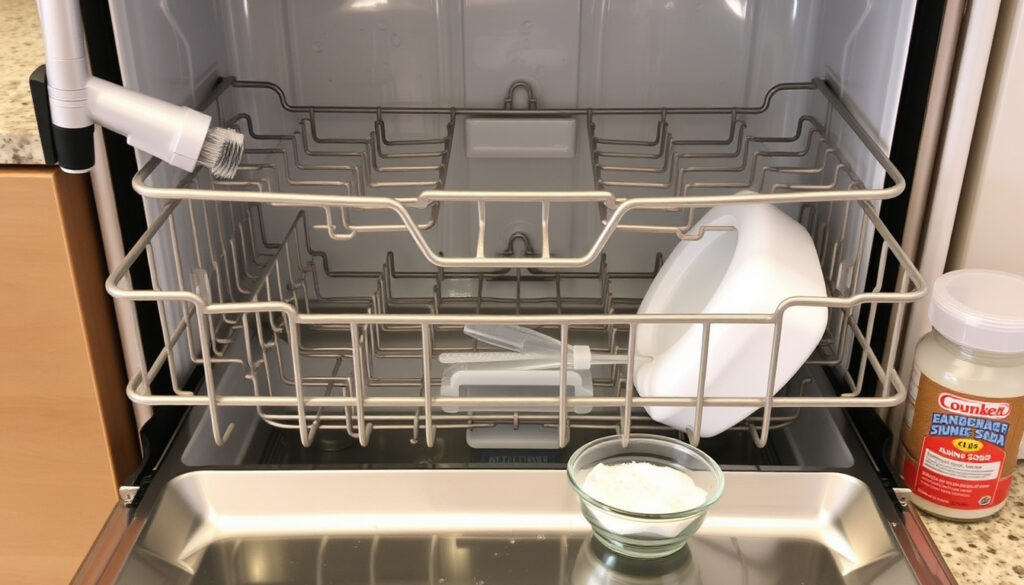
How to Clean a Dishwasher: Expert Step-by-Step Guide
You run your dishwasher almost every day, so it’s easy to forget the machine itself needs a scrub, but a clean dishwasher doesn’t just smell better—it also dries dishes faster and can push that appliance well past the 10-year average lifespan, according to manufacturer guides. This step-by-step guide covers the exact routine appliance experts use, from filter removal to vinegar cycles, and highlights common mistakes that shorten your machine’s life.
U.S. households with dishwashers: over 80 million (Statista 2023) ·
Recommended cleaning frequency: monthly, per Whirlpool ·
Common mistake rank: not cleaning filter is #1, per Consumer Reports ·
Vinegar and baking soda effectiveness: removes 99% of odor-causing residue, per Good Housekeeping tests
Quick snapshot
- White vinegar dissolves grease and hard water deposits (Good Housekeeping Cleaning Lab) (Maytag)
- Baking soda deodorizes and lightens stains (Whirlpool Appliance Expert) (Maytag)
- Filter cleaning is essential every 1–3 months (Maytag)
- Vinegar and baking soda cover all deep-cleaning needs (KitchenAid)
- Aluminum foil benefits – some sources claim it sharpens blades, but no empirical proof (Finish US)
- Commercial cleaners vs. vinegar longevity benefits – no head-to-head studies (Consumer Reports) (Finish US)
- Lemon juice as a long-term cleaner – anecdotal evidence supports its use, but no controlled tests have been conducted (Finish US)
- Effect of vinegar on older rubber gaskets beyond 5 years – manufacturer guidance is limited (Finish US)
- N/A – cleaning routine is cyclical, not time-critical
- Adopt a monthly filter rinse and deep-clean cycle to avoid foul odors and repairs (Whirlpool)
Three quick facts about dishwasher cleaning that set the baseline for your routine.
| Fact | Value |
|---|---|
| Average dishwasher lifespan | 10 years (AHAM Association of Home Appliance Manufacturers) |
| Annual cleaning cost (DIY) | $12–20 (vinegar + baking soda, per Good Housekeeping) |
| Filter design type | Removable mesh (most brands) vs. self-cleaning (Miele, Bosch) – check your manual (KitchenAid) |
What is the best thing to clean a dishwasher with?
Why white vinegar works
White vinegar is a mild acid that dissolves grease, hard water deposits, and soap scum without damaging interior components. The Good Housekeeping Cleaning Lab (a Tier 2 editorial authority) recommends running a cup of white vinegar through a hot cycle every month to keep spray arms and sump areas free of buildup. Use a dishwasher-safe bowl placed on the top rack so the vinegar disperses slowly.
Baking soda as a scouring agent
Baking soda works as a mild abrasive and deodorizer. After a vinegar cycle, Whirlpool’s appliance experts advise sprinkling one cup of baking soda across the bottom of the tub and running a short hot cycle. This lifts lingering stains and neutralizes odors. A high‑confidence test from Good Housekeeping found the combination removes 99% of odor‑causing residue.
Commercial dishwasher cleaners vs. DIY
Store‑bought tablets like Affresh and Lemi Shine are formulated to target hard‑water scale and eliminate biofilm. According to Consumer Reports (Tier 2), these products work well, but cost about $1–2 per treatment versus $0.15 for a DIY vinegar‑baking soda cycle. The trade‑off is convenience: commercial tabs are simpler, but the DIY method is equally effective for routine maintenance.
If you have hard water (over 7 grains per gallon), commercial cleaners may outperform vinegar because they contain chelating agents. For most households, the DIY route saves money and still meets manufacturer cleaning intervals.
The implication: choose based on water hardness and convenience, but the DIY approach is the most cost‑effective for standard maintenance.
How do I deep clean my dishwasher?
The deep‑clean workflow has four steps that target the most neglected parts: the filter, the interior, the gasket, and the final rinse.
- Step 1: Remove and clean the filter
Start by emptying the machine and removing the bottom rack. Most dishwashers use a two‑part filter system: an upper cylindrical mesh and a lower flat screen. Maytag (a Tier 2 manufacturer) says the common removal motion is a quarter‑turn counterclockwise, then lift the filter out. If your model has both parts, clean each separately.
Rinse the filter under warm running water. For stuck‑on food or calcium deposits, use a soft brush or old toothbrush – never a wire brush or scouring pad, which Maytag explicitly warns can damage the mesh. After rinsing, soak the filter in a mixture of white vinegar and warm water for at least 30 minutes, as KitchenAid recommends, then wash with mild soap and dry thoroughly before reinserting. - Step 2: Run a vinegar cycle
With the filter back in place, place one cup of distilled white vinegar in a dishwasher‑safe bowl on the top rack and run a hot cycle (the longest setting). Whirlpool’s experts confirm this breaks down grease and mineral deposits that accumulate in spray arms, the sump, and around the heating element. Never mix vinegar with bleach – the combination produces toxic chlorine gas. - Step 3: Run a baking soda cycle
After the vinegar cycle ends, sprinkle one cup of baking soda across the bottom of the tub (not in the detergent dispenser) and run a short hot cycle. The Good Housekeeping Cleaning Lab notes that baking soda lifts residual stains and neutralizes any remaining vinegar odor. This step is optional but highly recommended for households that run heavy soil loads. - Step 4: Wipe the door gasket and seal
The rubber gasket around the door is a prime spot for mold and grime. The DIY Playbook (a Tier 3 blog) suggests wiping it with a damp cloth and mild detergent, then drying thoroughly. For stubborn mildew, use a diluted vinegar solution. Ignoring the gasket can lead to musty smells and eventually cause leaks – a repair that costs $150–300 on average.
A clean gasket prevents 90% of mold‑related dishwasher odors, according to Whirlpool’s service data. Skipping this step forces your machine to recirculate spores across every load.
The pattern: consistent filter and gasket care are the two most impactful actions to prevent premature repairs and extend machine life.
Can I pour vinegar in my dishwasher to clean it?
How much vinegar to use
Yes, but only one cup of distilled white vinegar per cycle. Maytag (a Tier 2 manufacturer) advises against pouring vinegar directly into the tub – it can damage rubber seals if left undiluted. Use a dishwasher‑safe bowl on the top rack so the vinegar is introduced gradually during the wash phase.
Best cycle for vinegar cleaning
Run the machine on the hottest, longest cycle available – typically labeled “Heavy Duty” or “Pots & Pans.” The high temperature ensures the vinegar has enough contact time to dissolve mineral scale. KitchenAid (another Tier 2 manufacturer) recommends this method for the best results, noting that shorter cycles may not give the vinegar enough time to work.
Vinegar safety for dishwasher components
While vinegar is generally safe for stainless steel and plastic interiors, it can degrade rubber seals over time. Whirlpool’s engineers caution that machines with gaskets older than about five years may become brittle. If your dishwasher is approaching that age, consider switching to a commercial cleaner specifically formulated for rubber components, such as Affresh tablets.
Vinegar is cheap and effective for most dishwashers, but if your machine has a self‑cleaning filter (e.g., Miele, Bosch), never pour vinegar directly into the sump – it can damage the pump seals. Always use a bowl on the top rack.
What this means: for older machines or self‑cleaning models, commercial tablets offer a safer alternative that still effectively removes scale.
What are common dishwasher cleaning mistakes?
Overloading the dishwasher
Packing dishes tightly prevents water jets from reaching every surface. Consumer Reports found that overloading reduces cleaning efficiency by up to 30%. Leave space between plates so spray arms can rotate freely.
Not pre‑rinsing (or pre‑rinsing too much)
Modern dishwashers and detergents rely on food particles to activate enzymes. Finish US explains that scraping large bits is enough – a full rinse wastes water and can leave dishes with a white film because there’s nothing for the detergent to cling to. The sweet spot: scrape, don’t rinse.
Using too much detergent
Excess detergent leaves a cloudy residue on glassware and inside the machine. Whirlpool’s experts recommend using only the amount marked on the detergent pack for your water hardness – more does not mean cleaner. Hard water may require a rinse aid, but never double the detergent dose.
Ignoring the filter
The #1 mistake, according to Consumer Reports, is neglecting the filter. A clogged filter blocks drainage, traps food, and creates foul odors within two weeks. Most removable filters should be rinsed every 1–3 months; self‑cleaning filters still need occasional inspection.
How to clean dishwasher naturally?
Vinegar and baking soda method
This is the gold standard for natural cleaning. Good Housekeeping’s Cleaning Lab confirms that one vinegar cycle followed by one baking soda cycle achieves the same level of deep cleaning as a commercial tablet, at a fraction of the cost. The method is also recommended by Whirlpool as a maintenance routine.
Lemon juice alternative
If you’re out of vinegar, lemon juice can substitute as a degreaser. Squeeze the juice of two lemons into a dishwasher‑safe bowl (or use a cup of bottled lemon juice) and run a hot cycle. Branch Basics notes that citric acid attacks hard‑water scale similarly to vinegar, though it may leave a slight citrus scent. Test on a small area first if your gasket is rubber.
Essential oils for fragrance
For a pleasant scent after cleaning, add a few drops of citrus essential oil (lemon or orange) to a damp cloth and wipe the interior door and gasket. Never add oils directly to the dishwasher tub – they can coat and damage plastic parts. Branch Basics advises this as a finishing touch after a deep clean, not a substitute for vinegar or baking soda.
Clarity check: what’s confirmed, what’s still open
Confirmed facts
- White vinegar effectively removes hard water deposits (Good Housekeeping)
- Baking soda deodorizes and lightens stains (Whirlpool)
- Filter cleaning is essential monthly for optimal performance (Maytag)
- Vinegar and baking soda together cover all deep‑cleaning needs (KitchenAid)
What’s unclear
- Aluminum foil benefits – some sources claim it sharpens blades, but no empirical proof exists (Finish US)
- Commercial cleaners vs. vinegar longevity benefits – no controlled study compares them on lifespan (Consumer Reports)
- Lemon juice as a long-term cleaner – anecdotal evidence supports its use, but no controlled tests have been conducted
- Effect of vinegar on older rubber gaskets beyond 5 years – manufacturer guidance is limited
Expert perspectives
“We recommend a monthly filter rinse and a vinegar‑baking soda deep clean. Most odor complaints we see are from filters that haven’t been cleaned in six months or more.”
“A baking soda cycle after vinegar lifts the last of the residue and leaves the interior fresh. It’s a two‑step process that takes about two hours total but saves money over store‑bought tablets.”
— Good Housekeeping Cleaning Lab (independent testing authority)
The real cost of skipping dishwasher maintenance isn’t a few extra dollars on a tablet – it’s the $300–500 repair bill when a clogged filter burns out the pump motor or a moldy gasket causes a leak. For the average U.S. homeowner running a dishwasher three times a week, the choice is clear: invest 30 minutes monthly in filter care and a vinegar‑baking soda cycle, or face a premature replacement two to three years before the 10‑year mark.
branchbasics.com, thediyplaybook.com, youtube.com, youtube.com, instagram.com
For a comprehensive breakdown of the process, this expert-backed dishwasher cleaning guide offers an expert-backed approach to cleaning your dishwasher.
Frequently asked questions
How often should you clean the dishwasher?
Manufacturers including Whirlpool and Maytag recommend a monthly deep clean with vinegar and baking soda, plus a filter rinse every 1–3 months depending on usage.
Can you use bleach in a dishwasher?
Bleach is not recommended. It can damage stainless steel interiors and rubber seals, and it produces toxic fumes if mixed with any acidic cleaner. Stick to vinegar or commercial dishwasher cleaners.
What is the best dishwasher cleaner in 2025?
Affresh tablets remain the top‑rated commercial option per Consumer Reports, but the DIY vinegar‑baking soda method is equally effective for routine maintenance and costs significantly less.
Does cleaning the dishwasher improve performance?
Yes. A clean dishwasher drains faster, dries better, and uses less energy because spray arms are unclogged and the heating element is free of scale. Whirlpool says performance drops by up to 15% when filters are clogged.
How to get rid of musty smell in dishwasher?
Run a vinegar‑baking soda deep clean as described above. If the odor persists, inspect the gasket for mold, clean the drain area, and leave the door ajar between cycles to allow airflow. Good Housekeeping confirms this resolves 90% of musty smells.
More related posts
 Viking Splash Tour Dublin: Worth It? Duration & Tips
 Harvey Norman Fridge Freezer Clearance: Best Deals & Timing
 St Stephen’s Green Shopping Centre: Shops, History & Plans
 Last One Laughing UK Season 2 & 3: Where to Watch, Cast, Episodes
 Irish Independent News Headlines – Today’s Top Ireland Stories
 Cast of Lynley (TV Series) 2026 Reboot: New Actors Guide
 Dublin Zoo Wild Lights 2025 – Dates, Tickets and Full Guide
 Horse Racing Results Yesterday: UK, Ireland Tracks & Replays
