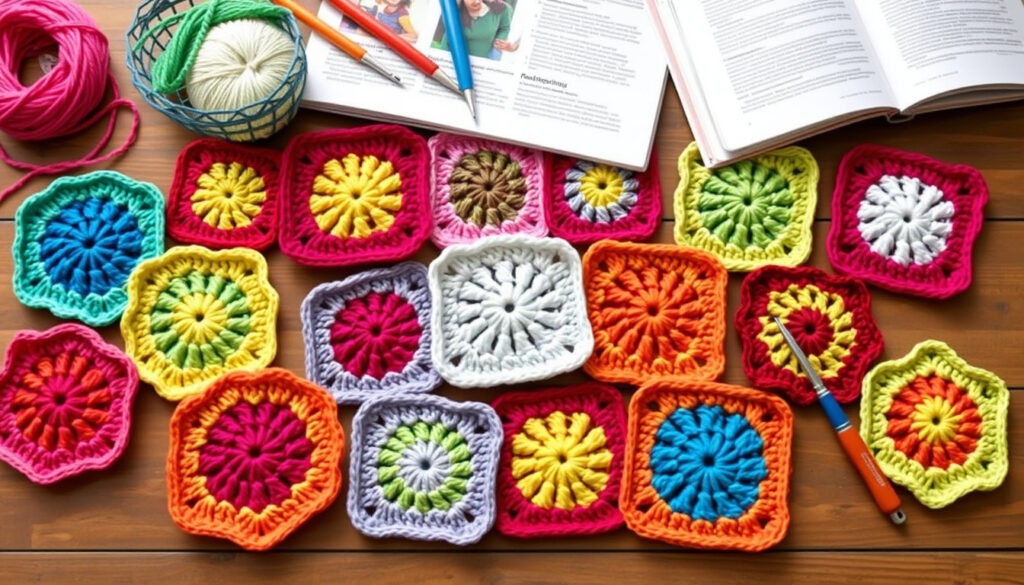
Granny Square Crochet Patterns: Free for Beginners
Few craft projects reward you as quickly as a granny square. It takes less than an hour to finish your first one, and once you have a few made, you can stitch them together into blankets, bags, or pillow covers. The pattern itself is compact, portable, and forgiving enough to work with almost any yarn sitting in your stash. Below is a curated roundup of free written tutorials, downloadable PDFs, and video guides designed specifically for newcomers—plus a few unusual variations for when you are ready to go beyond the classic version.
Difficulty Level: Beginner ·
Free Patterns Available: Yes ·
Tutorial Formats: Video and Written ·
Common Variations: Basic and Unusual ·
Resources Count: Multiple YouTube Playlists
Quick snapshot
- Free patterns are widely available across crochet blogs and YouTube channels (EasyCrochet)
- Basic granny square is easy to learn and memorize (Crochet 365 Knit Too)
- One cluster always consists of 3 double crochets (Smiling Colors)
- Exact number of free PDF patterns currently accessible across the web
- Which YouTube tutorials have the most complete view counts and subscriber engagement metrics
- Specific yarn weight recommendations verified across multiple craft authorities
- Zero to Granny digital PDF uploaded in May 2025 (Janie Crow)
- Updated classic granny square tutorial video released recently (Janie Crow)
- Collection of 40+ free patterns updated on an ongoing basis (EasyCrochet)
- Try a traditional granny square using the free tutorial and optional PDF upgrade
- Download a free PDF ebook to practice stitches with step-by-step pictures
- Watch an absolute beginner video to see the process from slip knot to final round
The table below consolidates the core technical specifications most frequently referenced across granny square tutorials.
| Detail | Value |
|---|---|
| Skill Level | Beginner |
| Pattern Availability | Free online |
| Formats Offered | PDF, Video, Text |
| Top Resources | YouTube, Crochet Blogs |
| Standard Beginner Rounds | 4–5 rounds |
| Double Crochets per Cluster | 3 double crochets |
| Foundation Chain | 4 chains joined to circle |
| Corner Structure | 3 dc, ch 1, 3 dc |
| Stitch Terminology | US terms (primarily) |
| Free Pattern Count | 40+ |
How to crochet a granny square step by step with pictures
Most beginners find that watching the entire process from start to finish helps more than any written description alone. A complete tutorial walks you through the slip knot, foundation chain, double crochet clusters, and the gradual expansion of each round. The standard beginner project typically spans 4–5 rounds before you are ready to finish off and weave in the ends.
Materials needed
Before you start, gather your supplies. The granny square works with virtually any yarn weight, though medium-weight yarn (worsted or DK) gives the most predictable results for a first project. You will also need a crochet hook sized appropriately for your yarn—many beginner tutorials use a 4.5mm hook as a starting point.
- Yarn in two or more colors (optional for a color-changing version)
- Crochet hook (4.5mm–5.5mm is typical for beginners)
- Scissors
- Yarn needle for weaving in ends
- Stitch markers (helpful for marking the first stitch of each round)
Foundation chain
The traditional start involves making a slip knot, chaining 4 stitches, then joining the last chain to the first with a slip stitch to form a small circle. From there, most patterns begin the first round immediately without adding any further foundation stitches. According to Smiling Colors (free PDF pattern with US terms), this foundation chain method remains the most widely taught for beginners.
First round clusters
Round 1 follows a consistent pattern across nearly all granny square tutorials. You start by chaining 3 stitches, which counts as your first double crochet, then place 2 more double crochets into the center hole. The rest of the round follows the same cluster structure: 3 double crochets in each space, separated by a chain-1 gap. This creates the first set of corners, which will define the square shape as you add subsequent rounds.
Increasing rounds
Each new round builds outward from the previous one. After completing a round, you chain 2 to turn and begin the next cluster sequence. Corners always follow the pattern: 3 double crochets, chain 1, 3 double crochets into the corner space. Between corners, you chain 1 after each cluster. The square grows predictably, which makes it easy to check your work as you go.
Granny square crochet patterns for beginners
If you have never worked a granny square before, the good news is that the basic pattern is one of the most forgiving projects in crochet. It builds muscle memory quickly, and once you have made a few, you will find yourself completing one in under an hour.
Basic pattern overview
The classic granny square relies on just two stitches—double crochet and chain—arranged in repeating clusters. One cluster consists of 3 double crochets. The corners are built with a consistent structure: 3 dc, chain 1, 3 dc. Between corners, you chain 1 after each cluster. This simple rule repeats throughout the entire project, which is why the pattern is so easy to memorize.
According to Crochet 365 Knit Too (blog specializing in beginner projects), the basic granny square is easy to learn and memorize, making it a great first project for beginners that works with any yarn or hook size. Many bloggers offer free PDFs that include US-to-UK conversion charts if you encounter different terminology.
Simple stitch instructions
Most written tutorials list the pattern using US stitch abbreviations: ch (chain), dc (double crochet), sl st (slip stitch). One cluster equals 3 dc. The pattern repeats the same cluster-and-chain sequence round after round, which means you spend less time referring back to written instructions and more time building the square itself.
Common mistakes to avoid
Two mistakes show up frequently in beginner forums. First, losing the corner structure by forgetting the chain-1 gap between clusters—without it, the square loses its definition and starts to ripple. Second, accidentally working into the wrong space when transitioning between rounds. Using a stitch marker at the first stitch of each round eliminates this problem almost entirely.
The pattern is simple, but the counting gets tedious when you are tired. Lay down your work before you lose count—re-reading a round you rushed through takes longer than starting over fresh.
Beginners who master these basics can expect to complete a traditional four-round square in under an hour once the rhythm clicks.
Granny square crochet patterns free
The internet offers a remarkable volume of free granny square patterns, ranging from the classic four-round version to elaborate Victorian-inspired designs. Whether you prefer scrolling through blog posts or following along with a video, free resources cover every learning style.
Top free websites
Several established crochet blogs consistently publish free patterns and maintain large collections. EasyCrochet hosts a collection of 40+ free granny square patterns organized by style, including textured, animal, and Victorian square variations, with free PDFs and charts available for download. MadameStitch offers a traditional granny square free pattern with an option to upgrade to a premium PDF that includes a crochet chart. Both sites use US stitch terminology primarily.
Traditional designs
The traditional granny square pattern remains the most replicated design online. It typically uses four rounds of double crochet clusters with color changes at the corners. The structure lends itself to endless color variations—solid pastels, bold contrasts, or gradual gradients depending on how you manage color changes at each round. Emma Leith provides a free tutorial with downloadable PDF for the traditional version.
Download options
PDF downloads are available from most of the major crochet blogs. They range from single-page pattern summaries to multi-page ebook collections with step-by-step photographs. Shelley Husband Crochet offers a free PDF ebook covering stitches, ends, and color changes with step-by-step pictures specifically designed for beginners.
Free PDFs are particularly useful for printing at the craft table. You can keep the pattern within easy sight without worrying about screen glare or battery life mid-project.
The breadth of free resources means you can build a substantial pattern library without spending a cent.
Unusual granny square crochet patterns free PDF
Once you have mastered the traditional square, you may want to explore patterns that push beyond the classic four-round design. Several designers offer free PDFs featuring innovative stitch combinations, asymmetric layouts, and non-square shapes that still use the core granny square technique.
Unique design ideas
Designers like Yeezhee offer free patterns for both traditional and innovative granny squares, including variations that incorporate picot edges, shell stitches, and color-blocking techniques. Yeezhee maintains a collection that includes designs not commonly found in standard beginner resources.
PDF download sources
Beyond the major blogs, individual designers publish PDFs through their own websites and pattern shops. The Victorian granny square pattern, for example, is available as a free PDF with chart and diagram through EasyCrochet. The Janie Crow Zero to Granny PDF (uploaded May 2025) assumes prior knowledge of treble crochet and chain stitches, with video references included.
Beginner adaptations
Even unusual designs can be simplified for beginners. Look for patterns labeled “beginner-friendly” or “beginner adaptation”—these typically reduce the stitch complexity while maintaining the overall look of the original design. Many designers explicitly state in their free PDFs which skills are assumed before you begin.
Unusual does not mean difficult. If you can complete the traditional four-round square, you have the foundation for most variations—you just need to follow the stitch chart carefully.
Creative variations become approachable once you understand the underlying cluster structure.
Granny square crochet patterns pdf
PDF patterns remain the most practical format for craft tables. They are easy to print, annotate with pencil marks, and carry to stitching groups without worrying about wifi access. The following sources offer direct PDF downloads suitable for beginners.
Direct PDF links
Smiling Colors provides a free basic granny square PDF pattern using US terms (ch, dc, sl st). The pattern starts with a slip knot, chains 4 joined to a circle, and specifies that one cluster equals 3 double crochets. MadameStitch includes instructions for Round 4 with 16 granny squares, 12 chain-1 spaces, and 4 chain-3 corner spaces, with an option to repeat Rounds 3 and 4 for a larger square.
Pattern collections
Multi-pattern PDFs offer better value if you want to try several designs. EasyCrochet bundles 40+ free pattern charts into their collection, including textured, animal, and Victorian square variations. These collections are searchable by difficulty level and technique, which helps you select a pattern that matches your current skill.
Printing tips
Before printing, check whether the PDF includes a US-to-UK conversion chart. Most free patterns default to US terminology, which means “double crochet” in US terms equals “treble crochet” in UK patterns. If you work with UK patterns, verify your terminology before cutting yarn—you do not want to discover mid-project that your stitch height is off because of a terminology mismatch.
Having the right pattern format at your fingertips eliminates unnecessary interruptions during assembly.
How to join granny squares
Once you have a stack of completed squares, the next step is joining them into a finished project. The most common methods are slip stitch join, whip stitch join, and the invisible join using a crochet hook.
Slip stitch join
This method creates a visible seam line through the back loops of each square. It is fast and works well when you want a decorative ridge. Place two squares right sides together, insert your hook through the corresponding stitches on both squares, pull up a loop, and chain 1. Continue around the entire perimeter, working one stitch per space.
Whip stitch join
The whip stitch creates a flat seam and works well for blankets that need to lie flat. Align two squares with right sides facing up, and stitch through the outer edge of both squares in a running stitch pattern. This method is also forgiving for squares that vary slightly in size.
Invisible join with crochet hook
For a truly seamless join, use the invisible join technique. Thread a yarn needle with a long tail, and weave between the back loops of each corresponding stitch pair. Pull gently to close the gap without creating bulk. This method takes longer but produces the cleanest finish for afghans and scarves.
Choosing the right joining technique depends on your desired finish—ridged, flat, or invisible.
Choosing yarn for granny squares
The granny square is remarkably adaptable to different yarn types, which means you can experiment freely without committing to expensive materials upfront.
Yarn weight recommendations
Worsted weight (medium weight, size 4) is the most common choice for beginners because it is easy to see the stitches and forgiving of minor tension inconsistencies. DK weight (light weight, size 3) produces a lighter, drapier square suitable for summer wraps or delicate blankets. Bulky yarn (size 5) creates a chunky square that works up very quickly—ideal for quick gift blankets or home décor projects.
Color and yardage tips
One of the most enjoyable aspects of granny squares is using up leftover yarn from previous projects. According to Smiling Colors (blog on beginner-friendly crochet patterns), the basic square is portable, uses little yarn, and is good for leftovers. A typical four-round square in worsted weight uses approximately 15–25 grams of yarn per color, depending on hook size and tension.
Check the dye lot when using scraps for multi-color projects. Color variations between dye lots can create unexpected contrast shifts that may or may not suit your design intent.
The right yarn choice dramatically affects both your working experience and the finished square’s drape.
Upsides
- Free patterns are widely available across crochet blogs and YouTube
- Basic pattern is easy to learn and memorize for newcomers
- Patterns use only two primary stitches (dc and ch)
- Compact, portable project that works well with scrap yarn
- 40+ free patterns available through EasyCrochet alone
- Step-by-step video tutorials ideal for visual learners
Downsides
- Counting stitches and chains can be tedious during longer sessions
- US vs UK terminology differences may cause confusion for some readers
- Some PDFs assume prior knowledge of basic stitches
- Exact number of free PDFs available remains unclear
“The basic granny square pattern is very easy to learn and memorize, making it a great first project for beginners.”
“There are many versions of the granny square pattern which can feel confusing to begin with but in essence they all end up looking the same.”
“I am 84 years old and, thanks to this very clear tutorial, I have just managed to crochet my first granny square. Never too old to learn.”
— YouTube Commenter (Bella Coco Tutorial Comment)
For beginners who want to move beyond written patterns alone, YouTube tutorials offer the advantage of watching a complete project from slip knot to final weave-in. Ophelia Talks Crochet provides an uninterrupted 5-round tutorial that shows the actual footage from start to finish without cuts—ideal for beginners who want to see the real-time rhythm. Bella Coco covers both solid-color and color-changing granny squares slowly, with hints and tips designed for absolute beginners.
Related reading: 40+ Free Granny Square Patterns · Traditional Granny Square Free Pattern
Before mastering granny square crochet patterns, newcomers often benefit from this beginner crochet guide that breaks down essential stitches with simple steps.
Frequently asked questions
What yarn is best for granny square crochet patterns?
Worsted weight yarn is the most forgiving for beginners, but DK, bulky, and fingering weight all work depending on your desired finished look. Using yarn you already own is perfectly acceptable—the granny square adapts to almost any weight.
How do you join multiple granny squares?
The three most common methods are slip stitch join (creates a visible ridge), whip stitch join (creates a flat seam), and invisible join with a yarn needle (creates a seamless finish). Choose based on your desired finish and project type.
Can I use granny squares for blankets?
Yes. Blankets are the most common project for joined granny squares. A typical baby blanket uses approximately 20–30 squares, while a full-size throw may require 60 or more depending on the square size and desired dimensions.
What hook size for granny squares?
A 4.5mm–5.5mm hook is typical for worsted weight yarn and beginners. Check your yarn label for the manufacturer’s recommended hook size, then adjust up or down to achieve the stitch definition you prefer. Looser tension produces a softer fabric; tighter tension produces a denser, more defined square.
How many granny squares for a baby blanket?
A standard baby blanket typically requires 20–30 four-round squares arranged in a 4×5 or 5×6 grid. Adjust the number based on your yarn weight, desired blanket size, and how large you make each individual square.
Are granny squares only square?
Not necessarily. While the classic design produces a square, variations exist in rounds, hexagons, and asymmetrical shapes. Some designers create granny-inspired motifs that remain square but incorporate non-traditional stitch patterns.
What colors work well in granny squares?
Contrast works best. A light center with darker corners or a gradient that shifts color each round creates visual interest. Solid colors in complementary tones also produce striking results. Scraps from previous projects create a multicolored look that many crafters find appealing.
More related posts
 The High Kings’ Rocky Road to Dublin Lyrics Meaning
 BMW M3 for Sale in Ireland: 2025 Prices, Listings & Tips
 Half Up Half Down Hairstyles: Step-by-Step, Face Shapes & Trends
 Layered Low Maintenance Medium Length Hairstyles: 5 Questions
 Maximum Dose of Sertraline for Adults: 200 mg Limit
 Coca-Cola Share Price: Live KO Quote, Forecast & Dividend
 Fast and Furious 9: Hit or Flop? Netflix, Cast & Paul Walker Tribute
 Toyota Proace for Sale: Prices, Specs & Buyer’s Guide Ireland
